PAVE Program Vehicle Distribution Targets
PAVE Program Vehicle Distribution Targets Pakistan has officially moved one step closer toward electric transportation after the federal government approved the second phase of the Pakistan Accelerated Vehicle Electrification (PAVE) Program under the New Energy Vehicles (NEV) Policy 2025–30. The decision was approved by the Economic Coordination Committee (ECC), which also cleared a Rs. 9 billion package for the fiscal year 2026 to expand electric vehicle distribution across the country.
The government plans to distribute thousands of electric bikes, electric rickshaws, and loaders under the revised scheme. This latest move is being seen as a major effort to reduce petrol imports, lower transportation costs for ordinary citizens, and encourage environmentally friendly travel options in Pakistan. Rising petrol prices have already forced many people to search for affordable alternatives, and officials believe electric bikes can become a practical solution for daily travel.
Unlike previous government schemes that faced criticism because of complicated balloting systems and banking delays, the new PAVE Program is being introduced with several major improvements. The authorities have promised a faster process, easier financing, digital verification, and direct subsidies to manufacturers to reduce delays for buyers. Officials also say the updated structure will help middle-class families, students, office workers, and delivery riders who spend a large portion of their income on fuel every month.
You Can Also Read: Apni Khet Apna Rozgar Application Form
Federal Government Approves Rs. 9 Billion for Electric Vehicle Program
The approval of Rs. 9 billion for the PAVE Program shows that the government is now taking electric mobility seriously. The funding has been allocated for FY2025–26 under the NEV Policy framework. Officials say the project will work under a revenue-neutral model funded through the NEV Adoption Levy Act 2025, meaning the government aims to support the scheme without creating additional financial pressure on the national budget.
During the first phase of the program, thousands of people applied for electric bikes and rickshaws, but several administrative and verification issues slowed down the process. Many applicants complained about banking approvals, delays in confirmation, and confusion regarding subsidies. After reviewing those challenges, the government has now redesigned the second phase to make it more transparent and efficient.
According to officials, the updated system focuses on quick delivery and easier public access. The Engineering Development Board (EDB), State Bank of Pakistan, and pre-qualified manufacturers will jointly manage the subsidy and verification process to ensure smooth implementation.
Important highlights of the approved package include:
- Rs. 9 billion allocated for FY2025–26
- Program launched under NEV Policy 2025–30
- Subsidized electric bikes and rickshaws
- Focus on affordable transportation
- Reduced dependence on imported fuel
- Simplified application and verification process
- Faster vehicle delivery mechanism
- Digital monitoring and biometric verification
Officials believe this policy can slowly transform Pakistan’s transport sector over the next five years if implementation remains transparent and consistent.
You Can Also Read: Eid Al Adha 2026 Date And Day In Pakistan
Govt Announces New Distribution Targets for Electric Bikes and Rickshaws
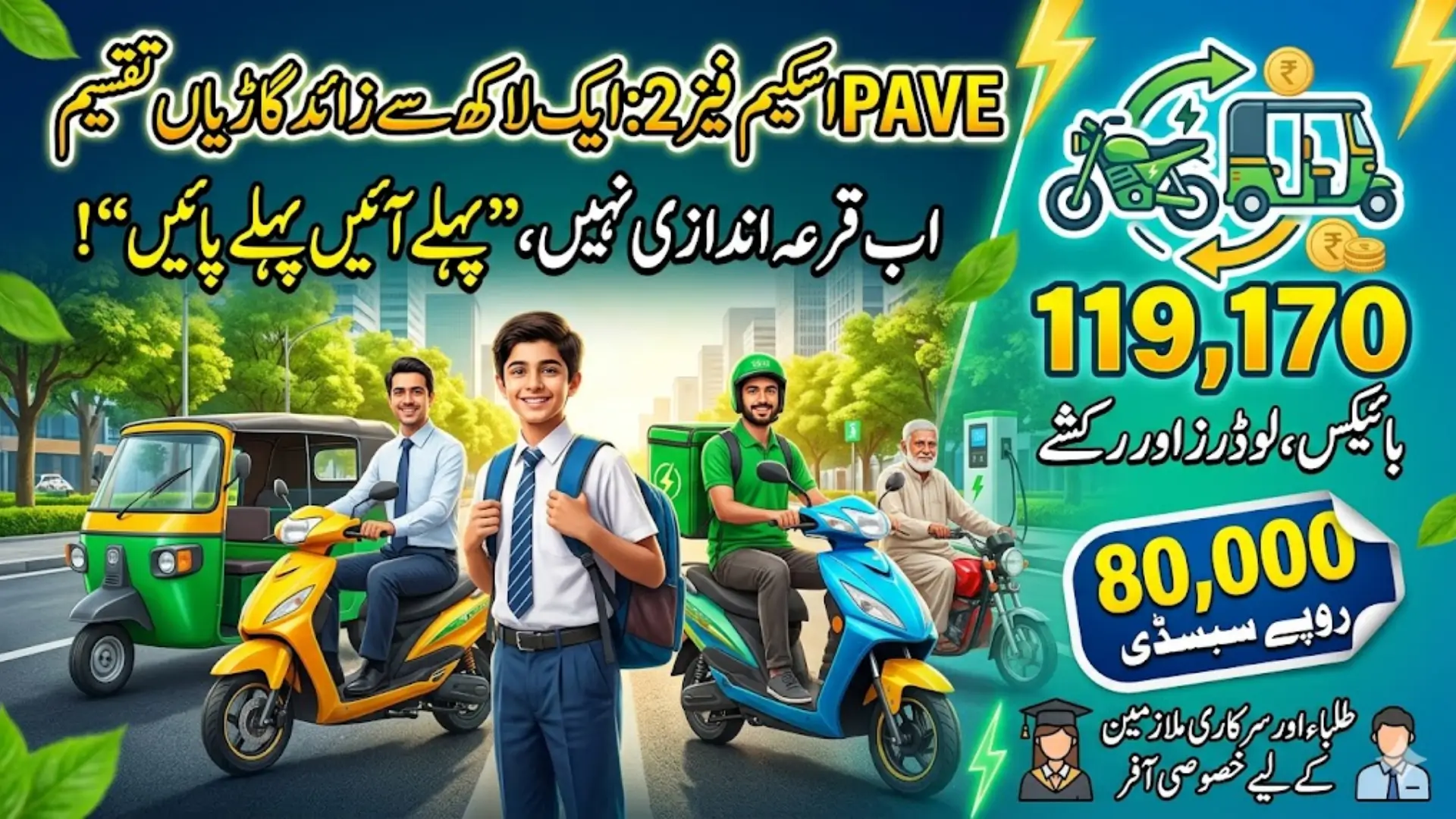
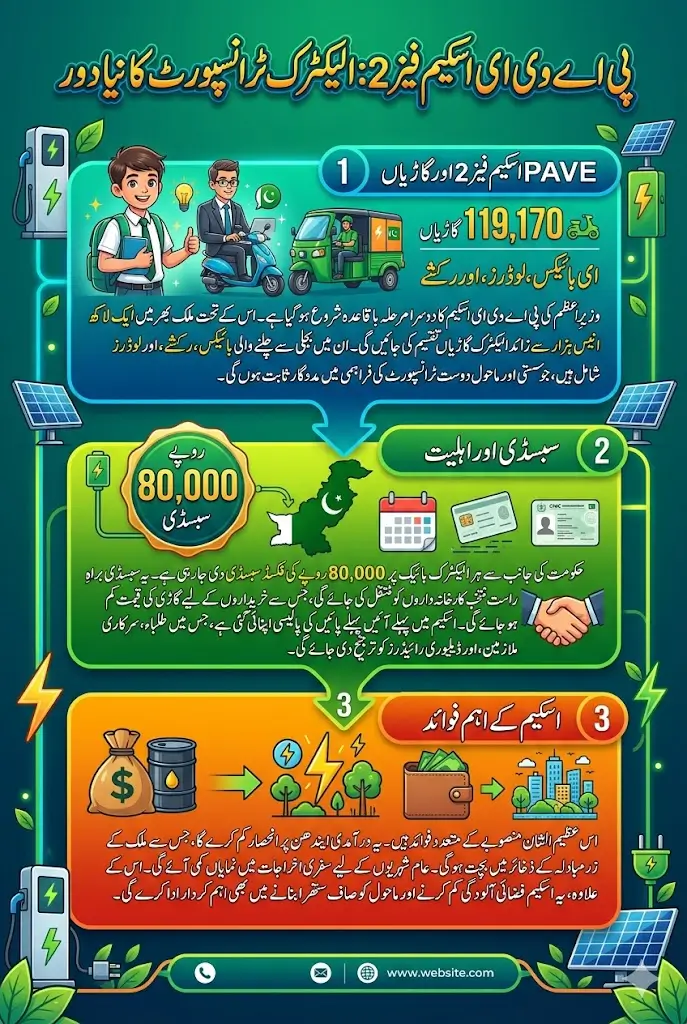
The federal government has announced ambitious targets for electric vehicle distribution under the second phase of the PAVE Program. According to official details, the overall target for the current fiscal year is 119,170 vehicles, including electric bikes, loaders, and electric rickshaws.
Authorities say the first pilot phase distributed around 41,000 vehicles, which encouraged the government to expand the project further. Under the revised second phase, the government now plans to distribute 76,000 electric bikes and 2,170 electric loaders and rickshaws. Officials are also discussing another fast-track rollout of 100,000 electric bikes within the next three months.
The government believes that electric bikes can provide relief to millions of Pakistanis struggling with increasing transportation costs. Daily commuters, students, office employees, and delivery riders are expected to benefit the most from this initiative because fuel expenses continue to rise across the country.
| Vehicle Category | Distribution Target |
|---|---|
| Electric Bikes | 116,000 |
| Electric Rickshaws & Loaders | 3,170 |
| Phase 1 Distribution | 41,000 |
| Phase 2 Electric Bikes | 76,000 |
| Phase 2 Rickshaws & Loaders | 2,170 |
Officials say Pakistan already has around 130,000 CKD kits available locally or in transit, which will help manufacturers speed up production and avoid supply shortages during distribution.
You Can Also Read: Prime Minister Apna Ghar Program
Rs. 80,000 Subsidy Announced for Electric Bike Buyers
One of the biggest attractions of the PAVE Program is the government subsidy for electric bikes. Under the revised policy, buyers will receive a fixed subsidy of Rs. 80,000 on each electric bike. This subsidy will not be handed directly to consumers. Instead, it will be transferred to pre-qualified Original Equipment Manufacturers (OEMs) after vehicle delivery and registration are verified.
The new subsidy system is designed to reduce confusion and delays that occurred during earlier government programs. Buyers will simply pay the remaining amount after the subsidy has already been deducted from the total vehicle price. The Engineering Development Board and the State Bank of Pakistan will verify registration and transfer payments to manufacturers.
Officials believe this new system will improve transparency and prevent misuse of subsidy funds. The government also plans to distribute vehicles in batches of 500 units to maintain proper monitoring throughout the process.
Key features of the subsidy model include:
- Rs. 80,000 subsidy per electric bike
- Direct subsidy transfer to OEMs
- Reduced upfront cost for buyers
- State Bank involvement in verification
- Faster payment settlement system
- Distribution in controlled batches
- Better transparency and monitoring
For many middle-class families, this subsidy may significantly reduce the financial burden of purchasing an electric bike for daily transportation.
You Can Also Read: Apni Chhat Apna Ghar Program 15 Lakh
First-Come, First-Served Policy Replaces Balloting System
The government has officially removed the balloting system that was previously used during the first phase of the PAVE Program. Many applicants had criticized the earlier lottery-based method because thousands of genuine applicants remained unsuccessful despite applying on time.
To solve this issue, authorities have now introduced a First-Come, First-Served system. Under this model, applicants who complete their applications earlier will receive priority during allocation. Officials say Phase 1 waitlisted applicants will also receive preference based on their original submission timestamps.
This change is expected to increase public trust because people will no longer depend on luck or random balloting results. Government officials believe the new policy will also speed up vehicle distribution and reduce complaints regarding unfair selection.
The revised selection process offers several advantages:
- Transparent vehicle allocation
- Faster approval process
- Priority for earlier applicants
- Reduced complaints about favoritism
- Easier tracking through digital records
- Better confidence among applicants
Many people who previously avoided applying because of the lottery system may now show greater interest in the scheme.
Electric Vehicle Scheme Expected to Reduce Petrol Consumption
Pakistan spends billions of dollars every year on fuel imports, and rising petrol prices continue to create economic pressure on both citizens and the government. Officials say the electric vehicle rollout can help reduce this burden by lowering fuel consumption nationwide.
According to official estimates, the current rollout may save around 8.6 million litres of petrol in the short term. Authorities believe the immediate economic benefit could reach nearly USD 8 million. Over the next five years, projected savings may cross USD 222 million if electric transportation adoption continues to increase steadily.
Experts believe electric bikes are particularly suitable for Pakistan because most urban commuters travel short distances daily. Electric bikes also require lower maintenance costs compared to traditional petrol motorcycles.
People expected to benefit the most include:
- Students traveling daily to colleges and universities
- Delivery riders working with online platforms
- Office workers commuting within cities
- Small business owners
- Ride-hailing service riders
- Families struggling with high fuel expenses
Environmental experts also believe the policy can reduce air pollution in major cities where traffic congestion continues to increase every year.
Government to Distribute Free Electric Bikes to Top Students
Alongside the public subsidy scheme, the federal government has also announced free electric bikes for talented students who secured top positions in HSSC examinations across Pakistan. Officials say around 600 electric bikes will be distributed among first, second, and third position holders from all 26 Boards of Intermediate and Secondary Education.
This initiative is being introduced not only as a reward for academic performance but also as a way to encourage young people to adopt modern and environmentally friendly transportation options. The estimated cost of this student support program is around Rs. 150 million.
Education experts believe this decision can motivate students to work harder while also supporting families who often face transportation difficulties for higher education.
Main details of the student bike initiative include:
- 600 free electric bikes announced
- Position holders from all BISE boards eligible
- Students from HSSC 2025 examinations included
- Estimated project cost Rs. 150 million
- Average bike price estimated at Rs. 250,000
Parents and students across Pakistan are likely to welcome this initiative because transportation costs have become a major issue for many households.
Easy Installment Plan Introduced for Government Employees
The government has also introduced a revised self-finance scheme specially designed for federal employees in BS-16 and below. Under this plan, employees can purchase electric bikes and rickshaws through easy installment options with very small down payments.
Officials say electric bike applicants will only need to pay Rs. 10,000 initially, while rickshaw applicants will submit Rs. 100,000 as a down payment. The remaining amount will be recovered through interest-free payroll deductions over a period ranging from 6 to 18 months.
This financing model is expected to help government employees who cannot afford full payments at once. Authorities believe the scheme may especially benefit lower-income workers who spend a significant portion of their salaries on petrol and transportation.
Key features of the installment scheme include:
- Rs. 10,000 down payment for bikes
- Rs. 100,000 down payment for rickshaws
- Interest-free salary deductions
- Flexible repayment duration
- Easy financing for government employees
- Support for lower-income households
Many experts say affordable installment options are necessary if Pakistan wants electric vehicles to become common among ordinary citizens.
Overseas Pakistanis and Fleet Operators Included in New Policy
The revised PAVE Program is not limited to ordinary local applicants. The government has expanded eligibility criteria to include overseas Pakistanis holding NICOP or POC documents, SECP-registered NBFCs, fleet operators, and public-private partnership projects.
Officials believe overseas Pakistanis can play an important role in supporting electric vehicle adoption by purchasing vehicles for family members living in Pakistan. Similarly, fleet operators and businesses may gradually shift toward electric transportation because operating costs are lower compared to petrol vehicles.
The government hopes this expansion will attract private sector investment and encourage commercial use of electric vehicles in urban areas.
Newly included categories under the policy include:
- Overseas Pakistanis with NICOP or POC
- Fleet operators
- NBFCs registered with SECP
- Housing-linked partnerships
- Commercial transport projects
Officials say broader participation will help strengthen Pakistan’s electric vehicle ecosystem over the coming years.
Digital Verification System Introduced to Reduce Delays
One of the biggest complaints during Phase 1 was the expensive and slow third-party verification system. Officials revealed that the old verification process was expected to cost more than Rs. 500 million, which increased delays and administrative pressure.
To improve efficiency, the government has replaced the previous system with a risk-based digital verification model. The new process will use biometric verification, digital records, and photographic evidence through the online portal.
Authorities believe this approach will make verification faster, cheaper, and more transparent for applicants.
Benefits of the new system include:
- Faster application approval
- Reduced verification costs
- Digital tracking of records
- Lower chances of fraud
- Easier biometric confirmation
- Improved operational efficiency
The government says the updated digital structure will help avoid many of the delays experienced during the first phase.
Dedicated EDB Team to Monitor PAVE Program
To manage the growing workload and ensure proper implementation, the Engineering Development Board will establish a dedicated 14-member unit for the PAVE Program. This team will supervise subsidy processing, distribution monitoring, registration verification, and coordination with manufacturers.
Officials say around Rs. 32.76 million annually has been allocated for the unit, while another Rs. 37 million has been approved for operational expenses during FY2025–26.
The dedicated management team is expected to improve coordination between banks, manufacturers, government departments, and applicants. Authorities hope this will ensure smoother execution of the project and faster delivery of vehicles across Pakistan.
Public Response Shows Massive Interest in Electric Bikes
The first phase of the PAVE Program received an overwhelming response from the public. According to official statistics, more than 269,149 applications were submitted despite limited financing approvals and technical delays.
Officials say the self-finance category achieved a delivery success rate of nearly 99.6 percent, which reflects strong public demand for electric transportation in Pakistan. Many citizens now see electric bikes as a practical option because petrol prices continue to rise almost every month.
People across urban areas are increasingly interested in electric bikes because:
- Fuel expenses are becoming unaffordable
- Electric bikes are cheaper to operate
- Maintenance costs are lower
- Daily commuting is becoming expensive
- Urban travel distances are shorter
- Charging costs are less than petrol prices
This strong public response suggests that Pakistan’s electric vehicle market may continue growing rapidly in the coming years.
Conclusion
The approval of the second phase of the PAVE Program under the NEV Policy 2025–30 represents a major step toward electric transportation in Pakistan. With subsidies, easy installment plans, free bikes for students, and a transparent First-Come, First-Served system, the government is trying to make electric vehicles accessible for ordinary citizens.
The success of the program will largely depend on transparency, quick implementation, and timely vehicle delivery. If managed properly, the scheme could reduce fuel imports, lower transportation expenses, support local manufacturing, and encourage cleaner transportation across Pakistan