
Cross Subsidy Program Electricity Eligibility Electricity bills in Pakistan are increasing so rapidly that many families now check their meter readings more carefully than ever before. Whether it is Lahore, Faisalabad, Karachi, Multan, Bahawalpur, or small villages in South Punjab, almost every household is discussing the same issue: how to reduce electricity bills in 2026. From middle-class families to salaried workers and daily wage earners, everyone is trying to understand whether the Cross Subsidy Program Electricity can actually provide relief.
A few nights ago, one of my relatives from Faisalabad called me after receiving his electricity bill. His first question was simple but important: “Yeh Cross Subsidy Program Electricity asal mein hota kya hai? Aur kya sach mein bill kam ho sakta hai?” Honestly, this confusion exists everywhere because thousands of Pakistanis are searching online for terms like electricity subsidy online registration, electricity bill relief program Pakistan, protected electricity consumer category, and Cross Subsidy Program Electricity 2026.
The main reason behind this growing search trend is simple. Families are now cutting unnecessary electricity usage, reducing AC timing, replacing old bulbs with LED lights, and switching to inverter appliances, but bills still feel extremely heavy. People want practical relief instead of complicated government language. That is why this guide explains everything in simple and human language that ordinary Pakistani consumers can easily understand.
The Cross Subsidy Program Electricity 2026 is being discussed as a relief-focused electricity support system for domestic consumers. The purpose behind such systems is to reduce the burden on households that struggle with rising electricity costs every month. Instead of giving separate cash payments like welfare schemes, electricity subsidy systems usually work directly through electricity bill adjustments and tariff-based relief.
In Pakistan, many families spend a large portion of their monthly income on electricity bills alone. During summer, electricity consumption increases sharply because fans, refrigerators, water motors, and air conditioners continue running for long hours. Even lower-middle-class households now carefully monitor electricity units because crossing certain slab limits can significantly increase monthly bills.
The concept behind the Cross Subsidy Program Electricity is to provide better support to deserving and lower-usage domestic consumers through controlled tariff structures. This system may help reduce billing pressure for families that remain within protected electricity categories.
Some major objectives of the program include:
Supporting low-income domestic consumers
Reducing electricity bill pressure
Encouraging controlled electricity usage
Protecting lower electricity usage households
Providing tariff relief through billing adjustments
Helping families stay within protected categories
One important thing many people misunderstand is that electricity subsidy programs usually do not provide separate cash payments. Instead, consumers may see reduced payable amounts directly inside their monthly electricity bills.
Why Electricity Bill Relief Programs Are Becoming More Important in Pakistan
Electricity has now become one of the biggest monthly household expenses across Pakistan. In many homes, electricity bills are discussed before grocery budgets because utility costs have increased continuously over the past few years. Families that once used appliances freely now carefully manage every extra unit to avoid entering expensive tariff slabs.
I personally know several households that now switch off unnecessary lights immediately, avoid ironing clothes during peak hours, and even reduce refrigerator cooling levels just to save electricity units. Some families check their electricity meters every week because even small differences in unit consumption can noticeably affect monthly bills.
The biggest challenge appears during summer months when electricity usage naturally increases. In cities like Faisalabad, Multan, Bahawalpur, and Lahore, high temperatures force people to run fans and cooling appliances continuously. Water motors also consume additional electricity because water shortages increase during hot weather.
Many Pakistani consumers are now focusing on:
Lowering monthly electricity units
Staying inside protected consumer categories
Using inverter technology appliances
Replacing traditional bulbs with LEDs
Avoiding unnecessary electricity wastage
Understanding subsidy and tariff systems better
Because of this growing financial pressure, electricity subsidy programs and relief discussions are becoming one of the most searched topics in Pakistan during 2026.
How Protected Electricity Consumer Categories Work
One of the most important things Pakistani consumers now discuss is the protected consumer category. Many people previously ignored electricity unit slabs, but now families understand that even crossing a small usage limit can increase electricity bills heavily.
Protected categories are usually designed for lower electricity usage domestic consumers. These categories often receive comparatively lower tariff rates and reduced billing pressure. That is why many households now monitor electricity consumption carefully throughout the month instead of waiting for the final bill.
For example, a family using controlled electricity units may receive more manageable billing compared to households consuming very high electricity. This difference becomes more visible during summer when electricity usage naturally rises.
Consumers now commonly focus on:
Keeping monthly units under specific limits
Avoiding unnecessary appliance usage
Using inverter ACs instead of old systems
Managing peak-hour electricity consumption
Reducing standby power usage
Many people are surprised to learn that even reducing 30 to 50 units monthly can noticeably affect the final electricity bill.
Who May Qualify for Cross Subsidy Program Electricity 2026?
Many consumers think every electricity connection automatically qualifies for subsidy support, but that is usually not the case. Eligibility often depends on several factors such as electricity usage, domestic classification, billing consistency, and consumer category.
Domestic electricity users are generally expected to receive priority because residential households face the highest pressure from increasing electricity costs. Commercial and industrial consumers may not receive the same level of relief because subsidy systems mainly focus on supporting ordinary families.
Consumers who may receive preference include:
Residential electricity account holders
Lower electricity usage households
Protected consumer category users
Budget-conscious domestic families
Consumers with stable billing history
Families using controlled electricity units
Electricity consumption plays a major role in determining eligibility. Lower-usage consumers are usually more likely to receive relief compared to households with extremely high electricity usage.
Another important factor is documentation accuracy. Consumers may need:
Valid CNIC number
Active mobile number
Correct electricity bill details
Properly classified domestic connection
Updated billing records
Incorrect information may delay or fail verification during registration.
Required Information Before Electricity Subsidy Registration
One common mistake many consumers make is starting registration without properly checking their electricity bill details first. This creates unnecessary problems later because even a small typing mistake can fail account verification.
Before applying for any electricity subsidy or relief system, consumers should carefully review all account information. Many people enter incorrect reference numbers or outdated mobile numbers, which creates verification issues.
The following information is commonly considered important during registration:
Required Information
Purpose
Electricity Bill Reference Number
Consumer account verification
CNIC Number
Identity confirmation
Registered Mobile Number
OTP and alerts
Consumer ID
Account matching
Latest Electricity Bill
Usage and category review
Consumers should also ensure that their electricity account is properly classified as residential because incorrect commercial classification may affect eligibility review.
Many people ignore small account mismatches for years and only discover them when applying for relief programs. That is why updating records early can save time later.
How to Apply for Cross Subsidy Program Electricity 2026
The exact registration process may depend on future official implementation and electricity provider systems. However, most modern subsidy systems now prefer digital registration and online verification methods because they are faster and easier for consumers.
People should always use official registration sources instead of random social media links. Fake websites and scam pages often copy government-style designs to steal consumer information.
The registration process may generally include:
Opening the official registration portal
Entering electricity reference number
Providing consumer ID information
Completing CNIC verification
Confirming mobile OTP code
Submitting billing details for review
After submission, the system may review several important factors such as:
Domestic consumer status
Monthly electricity usage
Billing consistency
Protected category eligibility
Account classification
If approved, subsidy benefits may later appear directly inside electricity bills instead of separate payments.
Electricity Distribution Companies Consumers Commonly Search About
Many consumers search online to check whether their electricity company is connected to subsidy discussions or relief systems. Pakistan has multiple electricity distribution companies, and consumers often want to know if their provider supports protected categories or billing relief programs.
The most commonly searched electricity distribution companies include:
LESCO for Lahore region
FESCO for Faisalabad region
MEPCO for Multan region
IESCO for Islamabad region
GEPCO for Gujranwala region
PESCO for Peshawar region
HESCO for Hyderabad region
SEPCO for Sukkur region
QESCO for Quetta region
TESCO for Tribal Areas
Policies and implementation methods may vary according to government decisions and electricity provider systems.
How Electricity Subsidy Benefits May Reflect on Bills
One of the biggest misunderstandings among consumers is the expectation of separate cash payments. In reality, electricity subsidy systems usually work through bill adjustments instead of direct cash transfers.
This means consumers may continue paying bills normally, but reduced payable amounts or tariff relief may appear automatically in billing calculations.
Consumers may notice benefits such as:
Reduced final payable amount
Lower tariff impact
Protected consumer adjustments
Controlled fuel adjustment pressure
Better billing rates for lower usage
The exact format may depend on electricity provider implementation and future policy decisions.
In many cases, people only realize the importance of protected categories after comparing bills with neighbors or relatives using slightly different electricity units.
Real-Life Example of Electricity Bill Reduction
One family I personally know from Bahawalnagar became serious about electricity savings after learning how protected electricity categories work. Their monthly bill had increased heavily during summer, and they realized small habits were increasing unnecessary electricity usage.
They started making practical changes at home instead of waiting only for government relief.
The family introduced several improvements:
Installed LED bulbs throughout the house
Reduced unnecessary AC usage
Used inverter fans
Switched off standby appliances
Controlled water motor timings
Avoided excessive ironing during peak hours
Within two months, their electricity bill reduced noticeably. The biggest lesson they learned was that awareness itself can create major savings.
Many Pakistani families can achieve similar results through careful electricity management.
Common Problems During Electricity Subsidy Registration
Although digital systems make registration easier, consumers still face several common problems during verification and submission.
One of the biggest issues is incorrect reference number entry. Many people accidentally type one wrong digit, causing verification failure.
Another common issue is delayed OTP verification. During high traffic periods, verification messages sometimes arrive late because thousands of users try accessing portals simultaneously.
Consumers also face problems such as:
Wrong consumer category classification
Slow registration websites
Mobile number mismatch
Outdated account information
CNIC verification delays
Some domestic users later discover their electricity account is incorrectly categorized as commercial, which may affect eligibility review.
That is why consumers should regularly review electricity records instead of waiting for subsidy announcements.
Important Safety Tips for Pakistani Consumers
Whenever electricity relief programs become popular online, scammers also become active very quickly. Fake agents and duplicate websites often target consumers searching for electricity subsidy registration.
Many innocent people share CNIC details and OTP codes without realizing the risks involved.
Consumers should always remember:
Never share OTP codes with strangers
Avoid fake approval guarantees
Use only official registration sources
Verify website authenticity carefully
Do not pay agents for guaranteed approval
Keep personal billing information secure
No genuine electricity subsidy system asks consumers to send money for approval confirmation.
Staying informed and careful is extremely important because online scams increase whenever public interest in subsidy programs grows.
Best Ways to Reduce Electricity Bills in Pakistan During 2026
Even without subsidy approval, small electricity-saving habits can reduce monthly bills significantly. Families that carefully manage electricity usage often notice major savings over time.
The most effective electricity-saving practices include:
Using inverter ACs and inverter fans
Installing LED lighting systems
Monitoring monthly electricity units
Avoiding unnecessary appliance usage
Reducing peak-hour electricity consumption
Switching off standby electronics
Managing refrigerator cooling properly
Running washing machines with full loads
Many people think only major changes reduce bills, but small daily habits often create the biggest long-term savings.
Final Thoughts
The reason why “Cross Subsidy Program Electricity” is becoming one of Pakistan’s top electricity-related search topics in 2026 is very simple. Families across the country genuinely want relief from continuously increasing electricity bills.
From what I have personally observed, people are not asking for luxury lifestyles. Most households simply want fair electricity bills that match their income levels. Whether it is a salaried employee, shopkeeper, laborer, or pensioner, everyone now wants better understanding of electricity subsidy systems and protected consumer benefits.
Treet Introduced A New Lithium Battery LINE Pakistan’s solar industry is expanding rapidly, and the demand for reliable energy storage solutions is also increasing with every passing month. In recent years, people across Pakistan have started shifting toward solar systems because electricity bills have become difficult to manage for middle-class families, small businesses, and industrial users. Along with solar panels, the need for efficient backup batteries has also become one of the biggest concerns for consumers.
In this situation, Treet Battery Limited has officially launched a new lithium ion battery product line under the brand name “Lithion NeoPower.” The company announced that this launch is part of its future expansion strategy in advanced battery technologies and energy storage solutions. The move is being seen as an important step because Pakistan’s lithium battery market is growing very quickly due to increasing solar adoption and rising electricity tariffs.
The newly launched Lithion NeoPower series includes residential energy storage systems and lead acid replacement batteries designed for homes, offices, shops, and commercial users. According to the company, these systems combine rooftop solar integration, hybrid inverter compatibility, intelligent battery management systems, and modern lithium ion technology to provide improved energy efficiency and long-lasting backup performance.
Treet Battery Expands Into Modern Lithium Ion Technology
For many years, Treet Battery remained known for its conventional battery products in Pakistan. However, the market is changing rapidly, and companies are now focusing on future-ready energy technologies instead of relying only on traditional systems. By introducing Lithion NeoPower, Treet Battery has officially entered the lithium ion battery market, which is considered one of the fastest-growing sectors in Pakistan’s renewable energy industry.
The company informed the Pakistan Stock Exchange that this new product line is part of its broader strategy of innovation, diversification, and expansion into advanced energy storage solutions. This means the company does not want to remain limited to old battery technologies only. Instead, it plans to compete in the growing solar and lithium battery sector where demand is increasing continuously.
Across Pakistan, the use of solar systems has increased massively in cities as well as rural areas. In places where load shedding remains common, people are now investing in complete solar backup systems to reduce dependence on expensive grid electricity. Because of this shift, lithium ion batteries are now being considered a modern and reliable option for long-term energy storage.
Important Highlights of Lithion NeoPower
New lithium ion battery product line launched by Treet Battery
Brand name introduced as “Lithion NeoPower”
Designed for residential and commercial applications
Supports solar energy systems and hybrid inverters
Includes advanced battery management technology
Focused on efficient and reliable energy storage
Developed as a replacement for conventional lead acid batteries
What Makes Lithion NeoPower Important for Pakistani Users?
Pakistan’s energy crisis has changed consumer behavior during the last few years. Earlier, most people only used UPS systems during load shedding. However, now consumers are investing in complete solar energy systems with backup batteries because electricity costs are becoming unaffordable for many households and businesses.
Lithion NeoPower has been introduced specifically to meet this growing demand. The system is designed to store electricity generated through rooftop solar panels so users can use backup power during nighttime, peak hours, or electricity outages. This can help users reduce dependency on WAPDA electricity while also lowering monthly electricity expenses.
Another important factor is battery efficiency. Traditional lead acid batteries lose efficiency over time and require regular maintenance. Many users complain about battery water issues, reduced backup timing, and short lifespan. Lithium ion batteries solve many of these problems by providing stable performance with lower maintenance requirements.
The company says the new battery line combines intelligent energy management systems with advanced lithium technology. This can help improve battery performance, charging control, and overall operational safety.
Residential Energy Storage Systems Explained
One of the biggest attractions of the Lithion NeoPower series is its residential energy storage system. These systems are designed for homeowners who already have rooftop solar panels installed or are planning to shift toward solar energy in the future.
The system integrates multiple technologies together, including:
Rooftop solar panels
Hybrid inverter systems
Battery energy storage
Smart energy management technology
This setup allows users to store extra electricity generated during daytime sunlight hours. Later, this stored electricity can be used during nighttime or power outages. In Pakistan, where electricity supply issues still exist in many areas, this can provide major convenience for families.
Another advantage is energy optimization. Smart battery management systems can help improve charging efficiency and reduce unnecessary power loss. This means consumers may get better backup timing and improved battery life compared to older systems.
Many solar users in Pakistan currently face problems because traditional batteries do not perform efficiently during extreme weather conditions. Lithium ion batteries are generally considered more reliable because they maintain better charging performance and energy output over longer periods.
Key Features of Residential Energy Storage Systems
Smart energy storage technology
Better compatibility with solar systems
Reduced electricity dependency
Improved backup during load shedding
Faster charging performance
Longer battery lifespan
Lower maintenance requirements
Stable power output for homes and offices
Lead Acid Replacement Series Offers Modern Alternative
Another major part of the Lithion NeoPower launch is the lead acid replacement series. This product line is specially designed for users who want to replace old UPS batteries or outdated backup systems with modern lithium alternatives.
In Pakistan, lead acid batteries have remained common for many years because they were cheaper and widely available. However, consumers often face issues such as:
Frequent battery maintenance
Water leakage problems
Heavy battery weight
Reduced charging efficiency
Short operational life
Weak backup during heavy usage
Lithium ion batteries are now becoming a preferred replacement because they solve many of these issues. They usually charge faster, provide longer backup timing, and require very little maintenance compared to traditional batteries.
Treet Battery says the Lithion NeoPower series uses advanced battery management systems that monitor temperature, charging cycles, and overall battery health. This technology can help improve battery safety and increase long-term performance.
Why Pakistan’s Lithium Battery Market Is Growing Rapidly
Pakistan’s lithium battery market has expanded significantly during the past two years. One major reason behind this growth is the increasing installation of solar panel systems across the country. In cities like Lahore, Karachi, Multan, Faisalabad, and Islamabad, thousands of consumers are now shifting toward solar energy to control rising electricity expenses.
The increase in electricity tariffs has also forced businesses to search for alternative energy solutions. Small factories, offices, clinics, schools, and commercial setups are now installing solar systems along with backup batteries to reduce operating costs.
At the same time, lithium ion batteries are gaining popularity because consumers are becoming more aware of long-term savings. Although lithium batteries have a higher initial cost, many users believe they are more economical over time because they last longer and perform better.
Another important reason is load shedding and unstable electricity supply in several areas of Pakistan. People now prefer backup systems that can provide reliable electricity without constant maintenance problems.
Main Reasons Behind Rising Demand
Rapid increase in electricity prices
Growth of rooftop solar installations
Need for reliable backup solutions
Increasing awareness about lithium technology
Long-term savings and improved efficiency
Better backup performance compared to lead acid batteries
Lithium Battery vs Lead Acid Battery – Which Is Better?
Consumers in Pakistan are now comparing lithium ion batteries and traditional lead acid batteries before purchasing solar backup systems. Both options have different pricing and performance levels, but lithium technology is becoming more attractive because of its efficiency and reliability.
Below is a simple comparison table for better understanding.
Feature
Lead Acid Battery
Lithium Ion Battery
Battery Lifespan
Shorter
Much Longer
Charging Speed
Slow
Fast
Maintenance
Regular Maintenance Needed
Very Low Maintenance
Weight
Heavy
Lightweight
Backup Efficiency
Moderate
High
Energy Loss
Higher
Lower
Solar Compatibility
Average
Excellent
Long-Term Value
Moderate
Better Investment
The table shows why lithium batteries are becoming the preferred option for modern solar systems. Many consumers now focus more on long-term reliability instead of only looking at initial purchase cost.
How Lithion NeoPower Can Benefit Homes and Businesses
For residential users, the new battery series can provide better electricity backup during load shedding and nighttime usage. Families with solar systems can store excess electricity generated during the daytime and use it later when needed.
For commercial users, reliable backup power is extremely important because power outages can affect daily operations. Shops, offices, clinics, and small businesses require stable electricity for computers, fans, lights, internet devices, and security systems. Lithium batteries can help provide smoother backup performance during electricity interruptions.
The lightweight design of lithium batteries is also becoming attractive for users who want compact energy storage systems. Unlike heavy traditional batteries, lithium systems are easier to manage and install.
The launch of Lithion NeoPower reflects a major change in Pakistan’s battery industry. Companies are now shifting toward advanced energy technologies because consumer demand is changing quickly.
Treet Battery appears focused on strengthening its position in the renewable energy sector by introducing modern lithium storage systems. Industry experts believe the company may continue expanding its lithium product portfolio in the coming years as the demand for solar-compatible batteries increases.
Pakistan’s renewable energy market is expected to grow further during 2026 and beyond. As more households and businesses move toward solar energy, the need for efficient battery storage systems will also continue rising.
This growing competition among battery manufacturers may eventually benefit consumers because companies will likely focus more on better quality, improved technology, and competitive pricing.
Final Thoughts
The launch of Lithion NeoPower by Treet Battery Limited marks an important development in Pakistan’s growing solar and energy storage industry. As electricity prices continue rising and more people shift toward renewable energy, lithium ion batteries are becoming an essential part of modern solar systems.
Treet Battery’s entry into the lithium battery market shows that Pakistani companies are now adapting to changing consumer needs and future energy trends. The company’s focus on residential energy storage systems and lead acid replacement batteries could help strengthen competition in Pakistan’s expanding solar sector.
Cross Subsidy Program 2026 Online Apply Electricity bills in Pakistan have become one of the biggest financial problems for ordinary citizens. In small cities, villages, and even major urban areas, families are now forced to spend a large part of their monthly income just to manage electricity expenses. Many households are already struggling with inflation, school fees, grocery prices, petrol costs, and medical expenses. In this situation, rising electricity bills are creating even more pressure for middle-class and low-income families.
To provide relief to deserving consumers, the government has introduced the Cross Subsidy Program 2026 through the CSS PITC portal. This new electricity subsidy scheme is specially designed for low-income consumers, BISP beneficiaries, and families using limited electricity units every month. Through this program, eligible consumers may receive discounts on electricity bills after successful verification.
The biggest advantage of this scheme is that people can complete the Cross Subsidy Program 2026 online apply process from home. There is no need to stand in long lines or repeatedly visit electricity offices. Consumers only need correct electricity bill details, CNIC information, and household records to submit their application online through the official PITC system.
The Cross Subsidy Program is becoming one of the most discussed relief schemes in Pakistan because millions of families are searching for ways to reduce electricity expenses. The government has designed this subsidy system to provide targeted support only to deserving consumers instead of offering equal relief to everyone.
Under this program, electricity consumers with lower usage and weaker financial conditions may receive monthly bill discounts. Officials believe that targeted subsidy systems are more effective because they help the people who genuinely need financial assistance.
Program Information
Details
Program Name
Cross Subsidy Program 2026
Registration Type
Online Registration
Portal Name
CSS PITC Portal
Main Benefit
Electricity Bill Discount
Eligible Users
Low-Income Consumers
Electricity Usage Limit
Mostly 200 Units or Less
Registration Fee
Free
Required Information
Electricity Bill Reference Number
This program is especially important because electricity costs are increasing continuously across Pakistan. Many citizens now reduce fan usage, avoid unnecessary lights, and limit appliance usage only to control monthly bills. For such families, even small bill relief can make a major difference.
Why Cross Subsidy Program 2026 Is Important for Pakistani Families
In recent years, electricity prices have increased so much that many families now consider utility bills one of their biggest monthly tensions. In both villages and cities, people often discuss electricity bills before discussing other household expenses. Daily wage workers and labour families suffer the most because their income is limited while inflation continues rising every month.
The government introduced the Cross Subsidy Program to help financially weak households survive during difficult economic conditions. Officials understand that many families cannot afford high electricity charges despite reducing their usage. This is why consumers using fewer electricity units are getting priority under the scheme.
This subsidy program may help:
Daily wage workers
Labour families
BISP beneficiaries
Low-income households
Pensioners
Small families with limited electricity usage
Financially struggling consumers
For many households, electricity bill savings can help manage important daily needs like medicines, children’s education, and grocery expenses. In rural areas especially, families often avoid using electrical appliances due to fear of large bills. Such consumers may finally receive some relief through this targeted subsidy system.
The Cross Subsidy Program 2026 is a government-backed electricity relief initiative created to support deserving electricity consumers across Pakistan. The system works through digital verification using electricity usage data, consumer records, and household financial information.
Unlike temporary relief packages announced for short periods, this scheme focuses on long-term targeted support for low-income users. The government wants subsidies to reach families who truly need financial assistance instead of benefiting high-income electricity consumers equally.
Through the CSS PITC portal, applicants can complete registration online by providing their electricity bill reference number and personal details. After submission, the system checks eligibility based on electricity consumption patterns and household records.
Many experts believe digital subsidy programs are better because they improve transparency and reduce corruption risks. Since the verification process is linked with official electricity data, authorities can identify deserving consumers more effectively.
The program also reflects the government’s effort to shift toward smarter welfare systems where relief is provided based on actual need instead of broad public announcements that often fail to help struggling households properly.
One of the biggest questions people ask is who qualifies for the Cross Subsidy Program 2026 online apply process. According to available information, the scheme mainly targets consumers with lower electricity usage and weaker financial conditions.
Families using around 200 units or less every month are expected to receive priority during verification. BISP beneficiaries and economically weak households may also qualify under current eligibility conditions.
Consumers who may qualify include:
Low-income households
BISP registered families
Consumers using fewer electricity units
Deserving electricity users
Economically struggling citizens
Small households with limited income
At the same time, consumers with high electricity usage may not receive subsidy approval because the program is mainly designed for smaller and financially weak households.
Applicants should also understand that online registration alone does not guarantee approval. Final eligibility depends on successful verification through the PITC system. Incorrect information or mismatched records may lead to rejection during the review process.
Documents Required for Cross Subsidy Program Online Registration
Before starting the online application process, consumers should prepare all necessary information carefully. One of the biggest reasons for delayed applications is incomplete or incorrect data submission.
The online registration system usually requires:
Electricity bill reference number
Valid CNIC number
Active mobile number
Household details
Updated BISP information if applicable
Many people make mistakes while entering electricity bill information or CNIC details. Even one incorrect digit can create verification problems later. Applicants should therefore check all information multiple times before final submission.
Consumers should also use a mobile number that remains active because future updates may be sent through SMS notifications. In many government schemes, inactive SIM cards create communication problems during verification stages.
Another important point is that applicants should only use their own genuine information. Fake details or borrowed electricity records may result in permanent rejection from the subsidy system.
Where to Apply for Cross Subsidy Program 2026
Citizens searching for Cross Subsidy Program online registration should use only the official CSS PITC portal. The government has already warned consumers not to trust fake websites, social media pages, or agents demanding money for registration.
The official PITC online system allows applicants to:
Submit subsidy applications
Check eligibility
Verify electricity details
Track application status
Receive subsidy updates
The biggest advantage of this online system is convenience. Earlier, people had to visit offices repeatedly for government schemes, but now most of the process can be completed from home through mobile phones or computers.
In rural areas where travelling to electricity offices can take several hours, online registration is especially beneficial. People can now apply without losing workdays or spending extra money on transportation.
Consumers should remain careful because many fake agents may try to misuse this opportunity by promising guaranteed approval in exchange for money. The government has clearly stated that the registration process is completely free.
Step-by-Step Cross Subsidy Program 2026 Online Apply Process
The government has tried to keep the registration process simple so ordinary citizens can apply without difficulty. Even people with basic mobile internet knowledge can complete the process if they follow the correct steps carefully.
Open the Official CSS PITC Portal
First, applicants need to open the official CSS PITC subsidy portal using a mobile phone, laptop, or desktop browser. It is better to use a stable internet connection to avoid interruption during registration.
Enter Electricity Bill Reference Number
The next step is entering the electricity bill reference number correctly. This number helps the system identify your electricity connection and verify monthly consumption details.
Many applications fail because people accidentally enter incorrect digits. Consumers should carefully match the number with the original electricity bill before submission.
Add CNIC and Household Information
Applicants must provide their CNIC number, active mobile number, and household details carefully. All information should match official records to avoid verification problems later.
Submit the Online Registration Form
After checking all details, applicants can submit the form online. Before pressing the final submit button, it is important to review every detail carefully because mistakes may delay approval.
Wait for Verification
After submission, authorities verify electricity usage records and financial information through the digital PITC system. Verification may take time depending on the number of applications received.
Receive Eligibility Result
Eligible consumers may receive confirmation after successful verification. Approved applicants may then receive electricity bill discounts according to government policy.
Where to Find Electricity Bill Reference Number
Many first-time applicants struggle to locate the reference number required for registration. Usually, this number appears near the upper section of the electricity bill and contains several digits used for consumer identification.
The reference number is extremely important because the entire verification system depends on correct electricity records. If the wrong number is entered, the system may fail to locate the consumer’s connection.
The reference number helps authorities:
Verify electricity consumption
Identify the electricity connection
Check eligibility records
Process subsidy applications
Consumers should avoid guessing numbers or using old damaged bills during registration. It is always safer to use a recent electricity bill with clearly visible information.
Common Mistakes During Cross Subsidy Registration
Thousands of online applications face delays because people make simple mistakes while filling out forms. Many consumers apply in a hurry without properly checking the information they enter.
Some of the most common mistakes include:
Wrong electricity bill reference number
Incorrect CNIC details
Typing errors in mobile numbers
Incomplete household information
Using unofficial websites
Applying multiple times unnecessarily
One major issue is repeated submissions. Some users think submitting forms multiple times increases approval chances, but this may actually confuse the verification system and delay processing.
Another common problem is fake agents. Many people fall victim to fraudsters who claim they can guarantee subsidy approval for money. Applicants should remember that the official registration process is free and no agent has special authority.
What To Do If CSS PITC Portal Is Not Working
Sometimes the portal may become slow or temporarily unavailable due to heavy traffic. During the first few days of registration, thousands of users often try to apply at the same time, which can overload the system.
If the portal is not working, consumers can try these solutions:
Refresh the website page
Use another browser
Check internet connection
Apply during late-night hours
Clear browser cache
Wait and try again later
People should avoid repeatedly clicking the submit button because this may create duplicate application errors. Patience is important during high traffic periods.
In many government online systems, temporary slowdown is normal when registration opens for large numbers of applicants across the country.
Is Cross Subsidy Program Registration Free?
Yes, the Cross Subsidy Program 2026 online apply process is completely free. The government has not approved any registration charges, processing fees, or paid agents.
Unfortunately, scammers often misuse such schemes by contacting innocent citizens through calls, WhatsApp messages, or fake social media advertisements. They may promise guaranteed approval in exchange for money.
Applicants should remember:
Registration is free
No fee is required
No agent is officially approved
Approval depends on verification
Personal information should remain protected
People should never share CNIC copies or personal details with unknown individuals online because cyber fraud cases are increasing rapidly in Pakistan.
How to Check Cross Subsidy Application Status
After submitting the online form, many applicants become worried about whether their application was approved or rejected. Usually, consumers can check application status through the same CSS PITC portal used during registration.
Applicants may need:
Electricity bill details
Tracking information
Registered mobile number
Consumers should save screenshots or confirmation messages after submission because these records may help if any issue arises later.
The government may also send updates through SMS notifications after verification is completed. Applicants should therefore keep their mobile numbers active during the entire process.
Why Consumers Using 200 Units or Less Are Getting Priority
The government introduced the 200-unit condition because lower electricity usage often reflects weaker financial conditions. Families with limited income usually consume less electricity to avoid large monthly bills.
This policy helps authorities identify deserving households more effectively. Instead of providing equal subsidies to wealthy consumers with heavy electricity usage, the government wants targeted relief to reach financially struggling families.
Consumers using fewer units are often:
Low-income households
Small families
Labour workers
Rural residents
Financially weak consumers
This targeted subsidy approach may also reduce unnecessary pressure on government finances while ensuring support reaches the people who truly need assistance.
How Cross Subsidy Program 2026 Can Help Pakistani Families
For wealthy households, electricity bill reductions may not matter significantly. But for struggling families, even small savings can help manage important daily expenses.
Many Pakistani households already reduce electricity usage because they cannot afford expensive bills. In villages and small towns especially, families often use fans, lights, and appliances very carefully during summer months.
This subsidy program may help families manage:
School fees
Grocery expenses
Medicines
Utility bills
Household needs
Emergency spending
For many deserving citizens, this scheme may reduce financial pressure during inflation and help improve daily living conditions slightly.
People across Pakistan are now hoping the government will continue expanding welfare programs focused on low-income households in the future.
Final Words
The Cross Subsidy Program 2026 Online Apply Via CSS PITC Portal system is becoming one of the most important electricity relief opportunities for Pakistani families facing rising utility costs. Through this targeted subsidy program, the government aims to support low-income consumers, BISP beneficiaries, and households using fewer electricity units every month.
The online registration process has made applications easier for ordinary citizens because people can now apply from home without visiting offices repeatedly. However, applicants must provide correct information and avoid fake agents or unofficial websites during registration.
Nadra App Pension Verification Government of Pakistan is finally moving toward a fully digital pension verification system for retired employees across the country. For many years, pensioners had to visit banks physically, stand in long lines, and complete manual verification just to continue receiving their pension payments. Elderly citizens especially faced serious difficulties during this process. Now, the government is introducing a modern “Proof of Life” system through NADRA applications to make the process easier, faster, and more secure.
Under the new policy, pensioners will be able to verify themselves digitally using biometric and facial recognition technology. Commercial banks will also connect directly with NADRA systems to confirm pension eligibility before releasing funds. Officials say this reform can improve transparency and stop fake pension claims in Pakistan.
Pakistan Introduces Digital Pension Verification System
The federal government has started working on a modern pension verification framework for around 1.7 million pensioners in Pakistan. The purpose of this system is to ensure that pension payments only reach eligible individuals. In the past, many pension departments relied on paperwork and physical verification, which created delays and increased chances of fraud.
Now, through the new digital process, pensioners will verify their identity through NADRA-linked applications. This system is being introduced under government reforms aimed at modernizing public services. Sources say the State Bank of Pakistan has also been asked to issue instructions to commercial banks for integration with NADRA databases.
The new “Proof of Life” system is a digital verification method introduced for pensioners. Instead of manually appearing at banks or pension offices, pensioners will now confirm their identity through NADRA’s digital applications.
This verification system will mainly use:
Facial recognition technology
Biometric thumb verification
NADRA family database records
Digital identity confirmation
The government wants pension verification to become simple and secure. Pensioners living in distant villages or cities will no longer need repeated physical visits for verification. Everything will gradually shift toward an online process.
Main Technologies Used in the System
System
Purpose
Pak ID App
Used by pensioners for Proof of Life updates
e-Sahulat App
Used by banks for verification
Nishan Pakistan API
Connects banks with NADRA databases
POLC System
Confirms pensioner is alive
FRC System
Verifies family and beneficiary details
How Pensioners Will Verify Through the Pak ID App
According to sources, the general public will use the Pak ID application for pension verification. This app is already used for several NADRA services, and now it will become part of the pension system as well.
The process is expected to be simple so even ordinary citizens can understand it easily. Pensioners may only need a smartphone, internet connection, and updated CNIC details to complete verification.
This process is expected to save time for millions of pensioners. Elderly people who previously traveled long distances for verification may now complete the process from home.
Role of Banks in the New Pension Verification Framework
Commercial banks will play a very important role in this new system. Before releasing pension payments, banks will digitally verify pensioners through NADRA systems. This means payments will only be transferred after successful verification.
The State Bank of Pakistan has reportedly been asked to direct all banks to integrate with NADRA platforms. Banks will use the e-Sahulat application and Nishan Pakistan API for this purpose.
Officials believe this integration can:
Prevent pension fraud
Improve banking transparency
Reduce fake beneficiary records
Make pension payments safer
Many pensioners in Pakistan have complained about delays in pension verification. With this new digital system, authorities expect faster processing and fewer errors.
POLC stands for Proof of Life Certificate. This certificate confirms that the pensioner is alive and eligible to continue receiving pension payments. Earlier, this verification often required physical appearances and manual paperwork.
Now NADRA will digitally verify the status of pensioners through biometric and facial recognition systems. Once verified, pension payments can continue without interruption.
The biggest benefit of POLC digitization is that:
Pensioners will avoid unnecessary visits
Banks can quickly confirm eligibility
Government departments can reduce paperwork
Verification becomes more secure
This is especially important for elderly pensioners who face health and travel issues.
The Family Registration Certificate, commonly called FRC, is another important part of the new pension system. This document helps verify family relationships and legal beneficiaries connected with the pensioner.
Authorities want to ensure that pension funds are only transferred to rightful individuals. By connecting pension verification with family records, the government hopes to reduce fraud and maintain accurate records.
Importance of FRC in Pension Verification
Feature
Benefit
Family Verification
Confirms legal family details
Beneficiary Validation
Helps identify rightful claimants
Record Accuracy
Reduces mistakes in pension data
Fraud Prevention
Stops misuse of pension funds
The integration of POLC and FRC systems is expected to create a stronger and more transparent pension structure in Pakistan.
Major Benefits of the New NADRA Pension Verification System
The government believes this system can completely change the pension process in Pakistan. For years, pensioners have faced difficulties due to outdated procedures and manual verification methods.
With the new digital framework, pensioners may experience faster and smoother verification. It can also improve public trust in government payment systems.
Key Benefits for Pensioners
Easier verification from home
Less dependence on paperwork
Faster pension disbursement
Reduced bank visits
Better security through biometrics
Lower chances of fraud
Officials also believe this system can save government resources by reducing manual operations.
One of the biggest reasons behind this reform is the increasing concern about fake pension claims and irregularities in payment systems. Manual verification methods created loopholes that could be misused.
In some cases, pensions reportedly continued even after the death of beneficiaries because records were not updated properly. The new system aims to close these gaps through real-time digital verification.
The government mainly wants to eliminate:
Fake pension records
Delayed verification processes
Manual paperwork problems
Duplicate beneficiary entries
Corruption in pension handling
Digital verification is now being considered the best solution for these long-standing issues.
Financial Relief and Reduced Verification Costs
Sources say NADRA has also proposed a revised financial model for this system. Under the proposal, some verification charges may be reduced or waived to make the system affordable and sustainable.
This cost-optimized structure may help both the government and pensioners. If approved, pension verification could become cheaper and more efficient compared to traditional manual methods.
Authorities are currently seeking approval from the Finance Division for this updated financial framework.
Challenges Pensioners May Face Initially
Although the system offers many advantages, some pensioners may face difficulties during the early stages. Many elderly citizens are not familiar with smartphone applications or online verification systems.
Internet access in rural areas can also create problems for some users. Biometric verification may sometimes fail for elderly people due to fingerprint issues or health conditions.
Possible challenges include:
Lack of digital awareness
Weak internet connections
Difficulty using smartphone apps
Biometric scanning problems
Need for public guidance campaigns
Experts believe the government should launch awareness programs to educate pensioners before full implementation.
Important Instructions for Pensioners
Pensioners should prepare themselves in advance for the upcoming digital verification system. Keeping records updated with NADRA can help avoid delays during verification.
It is also important to stay careful while using digital platforms and avoid sharing personal information with unauthorized individuals.
Important Things Pensioners Should Remember
Keep your CNIC updated
Use an active mobile number
Verify details only through official NADRA apps
Avoid sharing biometric information
Keep family records accurate
Follow official bank instructions carefully
These small steps can make the verification process smooth and secure.
Expected Implementation Timeline in Pakistan
Government sources say several parts of the policy have already been implemented. However, complete integration with commercial banks is still pending. Once the banking system connects fully with NADRA databases, the nationwide rollout may begin.
Experts believe this reform can become one of Pakistan’s biggest digital governance initiatives for pension management. The success of the project will largely depend on smooth coordination between NADRA, banks, and government departments. In the coming months, more official instructions and implementation details are expected to be announced.
Final Words
Pakistan’s new NADRA app-based pension verification system is a major step toward digital governance and transparent pension management. The old manual system created many difficulties for pensioners, especially elderly citizens who had to repeatedly visit banks and offices for verification.
Now, through biometric verification, facial recognition technology, POLC, and FRC integration, the government wants to create a secure and modern pension system. If implemented successfully, this framework can make pension payments faster, safer, and more transparent for millions of pensioners across Pakistan.
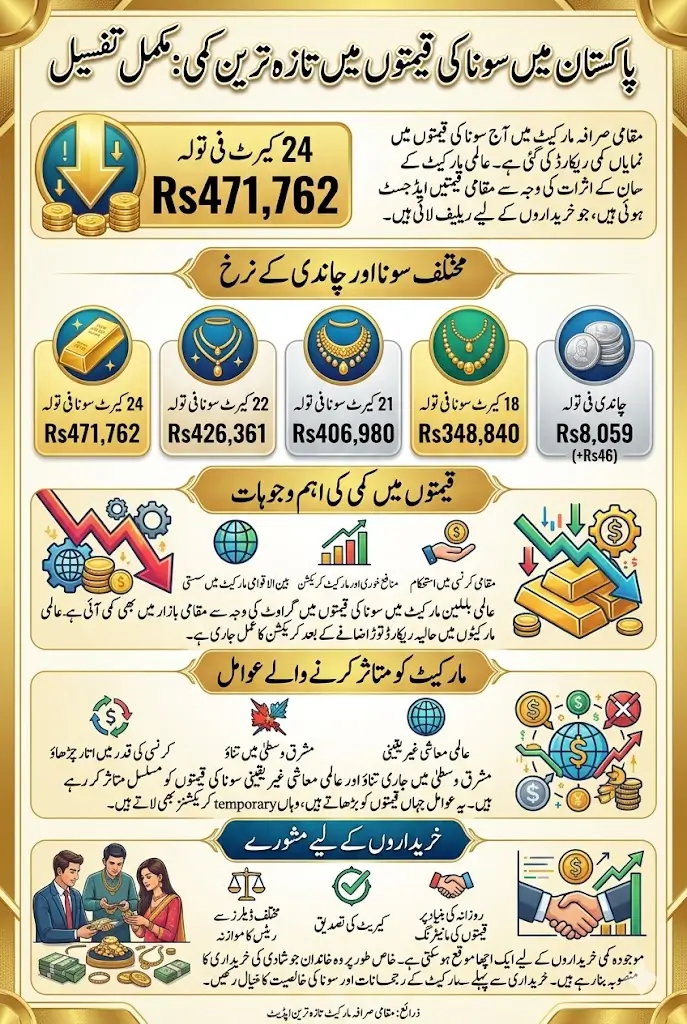
Gold Prices In Pakistan Declined Gold prices in Pakistan witnessed a major decline on Monday, giving some relief to buyers and investors after continuous price hikes in recent weeks. The decrease came after gold prices dropped sharply in the international market, which directly affected local bullion rates across the country. Jewellery traders in cities like Lahore, Karachi, Islamabad, and Multan reported that customers showed renewed interest after the latest reduction in prices.
According to market reports, the price of gold per tola decreased by Rs5,300 in a single day. This sudden decline became one of the biggest daily drops seen recently in Pakistan’s gold market. Experts believe international economic uncertainty, changes in investor behavior, and fluctuations in the dollar played an important role in bringing prices down.
Major Drop Recorded In Gold Prices Across Pakistan
The local bullion market remained under pressure throughout the trading day as gold prices continued to move downward. According to rates issued by the All-Pakistan Gems and Jewellers Sarafa Association (APGJSA), the price of one tola gold dropped to Rs488,362 after a decline of Rs5,300.
This decrease was important because gold prices in Pakistan had remained extremely high over the last few weeks. Many middle-class families were struggling to buy jewellery for weddings and other family events. After Monday’s drop, several jewellery markets saw an increase in customer visits as buyers hoped prices might decline further in coming days.
Gold traders explained that local prices are closely connected with international bullion rates. Whenever global prices move down, the Pakistani market also reacts quickly.
Latest Gold Price Update In Pakistan
Gold Type
Previous Price
New Price
Difference
Per Tola Gold
Rs493,662
Rs488,362
-Rs5,300
10 Gram Gold
Rs423,235
Rs418,691
-Rs4,544
Latest 10-Gram Gold Rate In Pakistan
The price of 10-gram gold also witnessed a significant reduction in local markets. After Monday’s decline, the new price reached Rs418,691, showing a decrease of Rs4,544 during the day.
In Pakistan, many people prefer buying gold in smaller quantities instead of full tolas because it is more affordable. This is especially common among salaried families and small investors who purchase gold gradually for savings or future needs. Because of this, the reduction in 10-gram prices was welcomed by many ordinary citizens.
Jewellers shared that buyers who had delayed purchases due to extremely high prices started visiting markets again. However, many people are still waiting to see whether prices will fall further before making final buying decisions.
The fall in Pakistan’s gold prices came mainly because of losses in the international bullion market. Reports showed that global gold prices dropped by $53 per ounce, bringing the international rate to $4,660 per ounce with an additional premium of $20.
International gold prices often change due to global economic conditions, inflation fears, interest rate decisions, and investor confidence. When international investors start selling gold for profit-taking, prices usually decline worldwide, including in Pakistan.
Currency fluctuations also affect local prices. Since Pakistan imports gold and deals mostly in US dollars for international trade, any change in global gold prices or dollar rates directly impacts local markets.
Role Of APGJSA In Gold Price Updates
The All-Pakistan Gems and Jewellers Sarafa Association (APGJSA) plays a major role in announcing daily gold and silver prices in the country. Traders, investors, jewellery shop owners, and customers rely on these official rates for buying and selling purposes.
Every day, the association reviews changes in international bullion markets and adjusts local prices accordingly. These rates become the standard benchmark for jewellery markets across Pakistan.
Many people trust APGJSA rates because they provide a clear picture of current market conditions. Whether someone wants to buy bridal jewellery or invest in gold bars, these official prices help consumers make informed decisions.
On Saturday, gold prices had already shown a small decrease of Rs400 per tola. At that time, the price stood at Rs493,662 per tola. However, Monday’s decline was much bigger and surprised many traders in the market.
This sudden reduction created discussions among investors about whether gold prices have finally started stabilizing after months of strong upward movement. Some market experts believe prices may continue fluctuating because international economic conditions remain uncertain.
Gold Price Comparison
Day
Per Tola Gold Price
Change
Saturday
Rs493,662
-Rs400
Monday
Rs488,362
-Rs5,300
Silver Prices Remained Stable Despite Gold Decline
Unlike gold, silver prices remained unchanged in Pakistan’s local market. The price of silver stayed stable at Rs8,513 per tola despite major movement in gold rates.
Market experts explained that silver demand and trading patterns are slightly different from gold. While gold is mostly considered an investment and safe-haven asset, silver has both industrial and investment value. Because of this difference, silver prices sometimes remain stable even when gold prices fluctuate heavily.
Jewellers said that silver jewellery and household items still have strong demand in local markets, especially in smaller cities and rural areas where silver remains more affordable compared to gold.
Several important factors contributed to the latest decline in gold prices both internationally and locally. Global economic conditions remained one of the biggest reasons behind the sudden fall.
Investors around the world often buy gold during uncertainty, but when market conditions improve or profit-taking starts, prices usually decline. Similarly, changes in US interest rates and the strength of the dollar also influence gold markets globally.
Main Reasons Behind Falling Gold Prices
Decline in international bullion market
Profit-taking by global investors
Fluctuations in the US dollar
Changing economic conditions worldwide
Reduced demand after record-high prices
Impact Of Falling Gold Prices On Pakistani Consumers
The reduction in gold prices brought some relief for Pakistani families, especially those preparing for weddings. In Pakistan, gold jewellery is considered an important part of marriage traditions, and rising prices had made purchases difficult for many households.
Several customers visiting jewellery markets said they were waiting for prices to drop before buying wedding sets and other ornaments. Monday’s decrease encouraged some families to restart their shopping plans.
Small investors also viewed the decline as an opportunity. Many people in Pakistan buy gold as a long-term saving option because it is considered safer than keeping cash at home.
Market analysts believe gold prices may continue showing fluctuations in the coming days because international economic conditions remain unstable. Future price movement will largely depend on global investor sentiment, inflation data, and currency exchange rates.
Experts advised buyers not to rush into large purchases immediately. Instead, they suggested monitoring market trends for a few more days before making investment decisions.
At the same time, jewellers believe that if international prices continue falling, local markets in Pakistan may witness further reductions, providing more relief to consumers.
Conclusion
Gold prices in Pakistan experienced a major decline on Monday after losses in the international market affected local bullion rates. The price of gold per tola fell by Rs5,300, while 10-gram gold also recorded a sharp decrease. This decline created relief for buyers, investors, and families planning wedding shopping.
Aghosh Program Online Check Punjab by CNIC Login 2026
Aghosh Program Online Check Punjab by CNIC Login 2026 Pregnancy is one of the most difficult and sensitive periods in a woman’s life, especially for families living in rural and low-income areas of Punjab. In many villages across Pakistan, women still struggle to access proper medical facilities during pregnancy because transportation costs, medical expenses, medicines, and repeated hospital visits are financially impossible for poor households. Many mothers delay treatment or avoid hospitals completely because they simply cannot afford regular healthcare.
To address this growing problem, the Punjab Government launched the Aghosh Program, a special financial and healthcare support initiative for pregnant women, lactating mothers, and children under two years of age. The purpose of this scheme is not only to provide cash assistance but also to improve maternal and child healthcare through regular medical checkups, vaccinations, hospital monitoring, and safe delivery practices.
In 2026, thousands of women are searching online for Aghosh Program Online Check Punjab by CNIC Login 2026, payment details, eligibility criteria, registration methods, and district coverage information. Many applicants still face confusion regarding verification procedures, required documents, healthcare visit conditions, and installment tracking. This detailed guide explains every important detail in simple and easy language so ordinary Pakistani families can understand the complete process without difficulty.
The Aghosh Program Punjab is a welfare and healthcare support scheme launched for financially struggling women during pregnancy and early motherhood. The program mainly focuses on helping women receive proper healthcare services without worrying too much about transportation costs, medicines, hospital visits, and child healthcare expenses.
In many underdeveloped areas of Punjab, women often rely on unsafe home deliveries because hospitals are far away or expensive. Healthcare experts have repeatedly warned that delayed treatment during pregnancy can create dangerous complications for both mothers and newborn babies. The Aghosh Program was introduced to encourage women to stay connected with formal healthcare systems from the beginning of pregnancy until the child reaches two years of age.
The program mainly supports:
Pregnant women
Lactating mothers
Mothers with children under 2 years
Low-income households
Rural families
Women requiring regular healthcare monitoring
Women who participate in medical checkups and healthcare visits receive financial assistance in stages. This system encourages continuous healthcare monitoring instead of one-time support.
Even today, many villages in Punjab lack proper maternal healthcare awareness. Women often ignore symptoms during pregnancy because of poverty, family pressure, transportation issues, or fear of medical expenses. In some areas, pregnant women only visit hospitals during emergencies, which increases health risks for both mother and child.
The Aghosh Program has become important because it directly connects healthcare participation with financial support. This means women are encouraged to attend regular medical checkups, vaccination visits, and healthcare monitoring sessions in order to continue receiving installments. The government designed this system carefully to improve maternal health conditions in poor communities.
Some major healthcare problems the program tries to reduce include:
Unsafe home deliveries
Pregnancy complications
Delayed medical treatment
Child malnutrition
Missed vaccinations
Infant health risks
Lack of healthcare awareness
Financial pressure on poor families
Healthcare workers in many districts report that more women are now visiting government hospitals regularly because of this initiative. This improvement is especially visible in rural areas where healthcare awareness was previously very low.
The Punjab Government launched the program with the goal of improving maternal and child healthcare across the province. The scheme is not simply about giving money to families. Instead, it focuses on creating long-term healthcare awareness while reducing financial stress for deserving households.
One of the biggest goals is to encourage women to visit hospitals regularly during pregnancy. Doctors say regular monitoring helps detect serious complications early, which can save lives and improve child health outcomes.
The program also aims to strengthen vaccination systems for newborn babies. Many children in villages miss important vaccines because parents avoid hospitals after childbirth. The Aghosh Program encourages families to continue healthcare visits even after delivery.
Main Goals of the Program
Objective
Benefit for Families
Improve maternal healthcare
Safer pregnancies
Encourage hospital visits
Better medical monitoring
Promote child vaccinations
Stronger child protection
Reduce healthcare expenses
Financial relief for families
Support poor women
Better healthcare access
Encourage safe deliveries
Reduced pregnancy risks
The government hopes this initiative will reduce maternal mortality rates and improve healthcare conditions in underdeveloped regions of Punjab over the coming years.
In 2026, the Punjab Government continues expanding healthcare monitoring and digital verification systems under the Aghosh Program. Many districts now use improved registration records and CNIC verification systems to reduce delays and improve transparency.
Women can now check their registration status, payment details, and healthcare records more easily through online systems and government healthcare centers. However, many rural women still prefer offline verification because internet access remains limited in remote areas.
Recent updates in the program include:
Improved CNIC verification system
Faster registration processing
Better healthcare monitoring records
Expanded awareness campaigns
Improved district-level coordination
Easier payment tracking system
Increased support for rural healthcare centers
Healthcare officials say these improvements are helping reduce confusion during registration and payment verification processes.
Who Can Apply for the Aghosh Program?
The program mainly targets deserving women from financially weak families who require healthcare assistance during pregnancy and early motherhood. Not every applicant automatically qualifies because the government prioritizes low-income households requiring urgent support.
Women must fulfill certain conditions before approval. Applicants are usually required to register through approved healthcare facilities and continue attending regular medical checkups throughout the program period.
Women eligible for the scheme include:
Pregnant women living in Punjab
Mothers with children under 2 years
Women from low-income families
Applicants with valid CNIC
Women registered at approved health centers
Important requirements include:
Regular healthcare visits
Medical checkup participation
Updated records
Correct CNIC information
Government healthcare registration
Women who miss appointments repeatedly may experience delays in installment payments because healthcare participation is a major condition of the scheme.
Aghosh Program Online Check Punjab by CNIC Login 2026
Many applicants now prefer checking their eligibility and payment status online instead of repeatedly visiting hospitals or healthcare offices. The online verification system helps women save time, transportation costs, and unnecessary travel.
The process is simple if applicants enter correct information carefully. Women can verify whether their registration is approved, pending, or under review. They can also check installment details and healthcare monitoring records through the system.
Step By Step Online Verification Process
Step 1 – Visit the Official Health Portal
Applicants should open the official Punjab healthcare portal related to the Aghosh Program. Always use trusted government sources instead of unofficial websites or social media links.
Step 2 – Open the Aghosh Program Section
After entering the website, locate the Aghosh Program or maternal healthcare section from the available categories.
Step 3 – Enter CNIC Number
Applicants should carefully type their valid CNIC number without spaces or incorrect digits. Even small mistakes can create verification errors.
Step 4 – Submit Information
Click the check status or login button to continue. The system may display:
Registration approval
Eligibility confirmation
Installment details
Healthcare visit history
Pending verification notices
Payment processing updates
Women should also keep their registered mobile numbers active because some notifications may be sent through SMS.
Although online systems are improving, many women in villages still do not have internet access or smartphones. Because of this, the government continues offering offline verification facilities through healthcare centers and hospitals.
In many rural communities, women feel more comfortable speaking directly with healthcare workers rather than using online systems. Healthcare staff can check records and guide applicants regarding missing documents or pending verification issues.
Women can verify their records through:
Basic Health Units (BHUs)
Rural Health Centers (RHCs)
Government hospitals
Maternal healthcare centers
Lady health workers
District healthcare offices
Healthcare officials encourage rural women to remain connected with nearby healthcare centers throughout pregnancy.
How Aghosh Program Payments Are Distributed
The Aghosh Program payment system works in stages. Financial assistance is linked with healthcare activities instead of one-time registration only. This system encourages women to complete regular medical checkups and continue healthcare monitoring for both mother and child.
Women usually receive support after completing specific healthcare visits. The total amount may vary slightly depending on district-level implementation and medical monitoring records.
Payments are generally connected with:
Initial registration
Pregnancy checkups
Delivery monitoring
Child vaccination visits
Follow-up healthcare visits
Child healthcare tracking
Many women use these payments for transportation, nutritional food, medicines, and baby-related expenses. Healthcare workers say the support may look small for some families, but for poor households it becomes an important source of relief.
Importance of Regular Medical Checkups
The biggest purpose of the Aghosh Program is improving healthcare participation. Doctors repeatedly explain that pregnancy complications can become dangerous if women avoid regular medical checkups.
Routine monitoring helps doctors identify blood pressure problems, nutrition deficiencies, child growth complications, and other health risks before they become severe.
Regular checkups help monitor:
Blood pressure levels
Baby growth and development
Mother’s nutrition
Pregnancy complications
Vaccination schedules
General maternal health
Healthcare experts say many serious childbirth complications can be prevented through early treatment and regular hospital visits.
Required Documents for Registration
One of the most common reasons for delayed verification is incomplete documentation. Many women visit healthcare centers without proper records, which slows the registration process.
Applicants should prepare all required documents before visiting the registration center.
Required documents usually include:
Original CNIC
Medical registration slip
Pregnancy healthcare records
Child birth documents if applicable
Active mobile number
Vaccination records
Applicants should also keep photocopies of important documents safely because lost records may create future problems during verification.
Common Problems During Registration
Many women face difficulties during registration because of small mistakes or lack of awareness about official procedures. In rural areas, incorrect information often causes delays in verification and payment processing.
Some common registration problems include:
Incorrect CNIC entry
Missed healthcare appointments
Unregistered healthcare facilities
Outdated family information
Wrong mobile number
Incomplete healthcare records
Women should immediately update information after childbirth or address changes to avoid future complications.
Practical Tips for Successful Registration
Women who carefully follow official instructions usually face fewer problems during registration and payment verification. Healthcare workers advise applicants to remain organized and connected with nearby health centers throughout pregnancy.
Important practical advice includes:
Register early during pregnancy
Attend every scheduled medical visit
Keep healthcare slips safe
Maintain updated records
Use only official information sources
Avoid fake agents and middlemen
Keep CNIC information accurate
Many scams target poor families by demanding registration fees. Applicants should remember that official registration is completely free.
How the Program Helps Rural Communities
The Aghosh Program is especially important for rural Punjab where healthcare facilities remain limited and transportation expenses are high. In many villages, women previously avoided hospitals completely because travel costs alone were unaffordable.
The program helps poor families connect with proper healthcare systems while reducing financial pressure. Many healthcare workers report that awareness about maternal health has improved significantly after the launch of the scheme.
Major benefits for rural communities include:
Increased hospital visits
Better maternal healthcare awareness
Improved vaccination participation
Safer delivery monitoring
Reduced healthcare delays
Financial relief for transportation expenses
This support is helping many families understand the importance of regular healthcare during pregnancy and early childhood.
Difference Between Aghosh Program and BISP
Many Pakistani families confuse the Aghosh Program with BISP because both schemes provide financial support to low-income households. However, the purpose of both programs is completely different.
The Aghosh Program mainly focuses on maternal and child healthcare, while BISP provides broader financial assistance to deserving families.
Major Difference Between Both Programs
Aghosh Program focuses on pregnancy and child healthcare
BISP provides general financial support
Aghosh payments depend on healthcare participation
BISP eligibility uses separate poverty evaluation systems
Women may qualify for both programs separately
Families should understand that healthcare monitoring is the main condition under the Aghosh Program.
Can Women Apply Without Internet Access?
Yes, internet access is not compulsory for registration or verification. The government understands that many rural women still lack smartphones or stable internet facilities.
Women can complete most procedures through physical healthcare centers and government hospitals.
Offline support is available through:
Government hospitals
BHUs
Rural healthcare centers
Lady health workers
Maternal healthcare units
Healthcare staff usually guide applicants regarding registration, verification, and installment updates.
Frequently Asked Questions
Can women from all Punjab districts apply?
Program coverage may vary depending on district implementation phases and healthcare availability.
Is online CNIC checking compulsory?
No, applicants can also verify their information through healthcare centers and hospitals.
How much financial assistance is provided?
The total support depends on healthcare visits, district implementation, and verification stages.
Can mothers with newborn babies apply?
Yes, mothers with children under two years may qualify under the program.
What happens if medical appointments are missed?
Installments may be delayed or temporarily suspended.
Is registration free?
Yes, official registration and verification are completely free.
Can women receive both BISP and Aghosh Program support?
Yes, women may qualify for both schemes separately if they meet eligibility conditions.
Are private hospitals accepted?
Usually government-approved healthcare facilities are preferred for registration and monitoring.
Conclusion
The Aghosh Program Punjab 2026 is becoming one of the most important maternal healthcare initiatives for low-income families in Punjab. For thousands of poor women, especially those living in villages and remote areas, the scheme provides financial relief during one of the most difficult stages of life.
By connecting financial assistance with regular healthcare visits, the program encourages safer pregnancies, proper vaccinations, hospital monitoring, and improved child healthcare. This approach is helping reduce healthcare negligence among poor families who previously avoided hospitals because of financial pressure.
Wazir E Azam Apna Ghar Program Ubl In my neighbourhood, I have seen some people want to buy ready-built houses while others want to build on their own land. UBL’s program helps you in both situations. If you already own land or want to buy land, the bank gives you money for all construction costs.
On the other hand, if you want to buy a ready-made flat or house, the bank offers this facility too. Following Sharia principles, this program protects you from interest and offers a halal solution. I have talked to many people who prefer Islamic banking, and UBL has created this program keeping them in mind.
Money available for both buying and building a house
Islamic banking solution based on Sharia principles
When I talked to people in Lahore, the first question was “Brother, how much money does the bank give?” The answer is very good. UBL provides money from 10 lakh rupees up to 1 crore rupees. This is enough for most Pakistani families.
There is also good news about the house size. You can build a house up to 10 marla (approximately 2,720 square feet) or buy a flat up to 1,500 square feet. When it comes to time, the bank gives a facility from 5 to 20 years. This means you can pay smaller amounts every month and slowly finish your loan according to your situation.
I once saw in Multan that one person preferred to finish the loan in 15 years, so his monthly payment was smaller. But those who wanted to finish in 10 years had higher monthly payments. This flexibility lets you decide based on your ability.
Let me explain with a real example. Say you take a loan of 50 lakh rupees and want to finish it in 10 years. Regular banks charge interest between 8 to 10 percent. If you pay 9% interest, you have to pay more than 60,000 rupees every month.
But with UBL’s program that has only 5% interest, you would pay around 48,000 rupees per month. That means saving 12,000 rupees every month! When you calculate this, it saves you 1.44 lakh rupees annually. Over 10 years, this could be around 14 lakh rupees.
I talked to an engineer in Islamabad who joined this program. He said with this kind of savings, he could spend more on his children’s education. This is why this program is changing lives for millions of people.
When people ask me “Can I join this program?” the first thing is to know UBL’s conditions. The basic requirement is that you must be a Pakistani citizen and have a valid CNIC. Obviously, this program is for people of Pakistan.
The second important condition – which I have seen many people misunderstand – is that this is only for first-time home buyers. If you already own a residential property, this program is not for you. The bank wants to help people who are still living in rented homes.
About age, you should be at least 25 years old and no more than 60 years old – that is, until the loan is finished. Regarding income, you should have a monthly net income of at least 40,000 rupees. In Karachi, I talked to a young man who worked a regular job and earned 45,000 rupees, and he could join this program.
Only for first-time home buyers
Pakistani citizens with valid CNIC
Age between 25 to 60 years
Monthly income at least 40,000 rupees
How Much Job or Business Experience Do You Need?
Here is another important condition that many people get confused about. You must have at least 3 years of experience in your current job or business. This condition exists so the bank knows your income is stable and acceptable.
I talked to a father in Peshawar who started his own business 2 years ago. He was very worried about when he could join the program. But when he learned that he just needs to wait one more year before joining, he was happy. Once you complete 3 years, you can apply.
This condition applies to both small business owners and employees. Whether you work in a bank or run your own shop, this condition is the same for everyone.
At least 3 years of job or business experience required
When I asked people “Are there any hidden bank fees?” many were worried. Because many Pakistani banks charge commissions and fees everywhere. But the good news with Wazir-e-Azam Apna Ghar is – there is no processing fee. You don’t have to pay any extra money for applying.
However, there are some other charges that are based on actual costs. Property valuation and legal report charges – these are real expenses. For example, if your house is worth 50 lakh rupees, the valuation fee could be a few thousand rupees. But it is not necessary that the bank charges this – sometimes they do this work themselves.
One very big thing is that if you pay off the loan early, there is no penalty. This means if you suddenly get money, you can finish your loan without any punishment. I saw a man in Multan who was on a 15-year program but when he got inheritance, he finished the loan in just 8 years.
I have heard from many people “Brother, I live in a small city, will I get this program here?” This is a fair question. The good news is that the Wazir-e-Azam Apna Ghar program is available in all major cities in Pakistan where UBL has branches.
UBL is one of Pakistan’s biggest banks and has branches in almost all major cities like Karachi, Lahore, Islamabad, Faisalabad, Multan, Peshawar, Hyderabad, Sukkur and Swat. UBL also exists in smaller cities. But it is better to first call the UBL branch near you and confirm that they are offering this program.
I contacted the UBL branch in a small city like Jhellum and they told me they offer this program. So it is very likely that it is available in your city too.
When I asked people “How many documents do we need for the application?” many said it would be troublesome. But the good news is that UBL has kept the number of documents low for this program.
First, the application form – you can download this directly from UBL’s website. If you work for a company, there is one form. If you run your own business, there is a different form. The best part is that these forms are also available in Urdu.
Second, a photocopy of your CNIC – you and if you have a partner, both CNICs are needed. This is necessary because the bank needs to verify your identity.
Third, proof of income. If you work for a company, you need the last three months of salary slips and an annual certificate. If you run your own business, you need tax returns and bank statements (for the last 6 months).
Fourth, property documents. If you already own land, ownership documents (like inheritance or purchase agreement). If you need to buy new land, details and location of the new land.
In Lahore, I talked to someone who said it was very easy – they prepared all documents in just one week.
Application form (in Urdu or English)
Photocopy of CNIC (yours and partner’s)
Salary slips or tax returns
Property documents
How to Contact UBL and Get Started?
When you decide this program is for you, the next step is to contact UBL. UBL’s customer care number is 111-825-888. This is a toll-free number, which means you can call from any SIM. When you call, directly ask about “Housing Finance” or “Wazir-e-Azam Apna Ghar”.
Another way is to go directly to the UBL branch near you. The staff there are very helpful and will guide you at every step. I have seen that some people get more information by visiting the branch directly.
Third, visit UBL’s website (www.ubl.com.pk) and download all documents and forms from there. You will find more details there.
When you join this program, there are some important promises you must make to the bank. First, you will remain a Pakistani citizen – this is a must. If you give up your citizenship for any reason, the bank has the right to take action.
Second, until you completely pay off the loan, the house will be mortgaged in the bank’s name. This means the house will formally be in the bank’s control. This is normal – any bank keeps this security to get their money back.
Third, you must open an account with the bank and deposit your monthly payment there. You can choose post-dated cheques, direct debit facility, or deposit it yourself.
In the fourth condition, the bank has the right to share your financial information with other agencies. This is so they can check that you don’t have defaults anywhere else.
Fifth, if you miss a month’s payment or have any problem, the bank can charge extra amounts. But this only happens if you continuously fail to pay.
Must remain a Pakistani citizen
House will be mortgaged to the bank while loan is active
Must open a bank account and deposit payment every month
Penalties can be charged for missed payments
Final Word
During my journalism career, I have talked to people in many cities across Pakistan including Karachi, Lahore, and Islamabad. In almost every meeting, people share one dream – to own their own home. But high interest, tough conditions, and large amounts of money always kept this dream far away.
UBL’s Wazir-e-Azam Apna Ghar program can turn this dream into reality. Low interest (only 5%), no processing fees, easy conditions, long tenure – all of this combined makes this program an opportunity for millions of Pakistani families.
PMWww.pha.gov.pk Online Apply For decades, ordinary Pakistani families have been trapped in a cycle of paying rent to landlords month after month, never building any equity or ownership. The Prime Minister Shehbaz Sharif has finally addressed this persistent problem by launching the PM Apna Ghar Scheme 2026, a revolutionary housing finance program that makes homeownership accessible to the common man. This is not just another government scheme – it is a comprehensive housing support system backed by Rs. 3.2 trillion in government funding with the ambitious goal of helping 500,000 families own their own homes within the next five years. If you have ever dreamed of living in your own house instead of paying endless rent to someone else, this article will show you exactly how to make that dream a reality.
The scheme addresses a fundamental problem in Pakistani society. According to recent data, millions of Pakistanis spend between 30-50% of their monthly income on rent, yet they have absolutely nothing to show for it at the end of their rental period. Under the PM Apna Ghar Scheme, that same money now becomes an investment in your own property. The government has made this possible by offering subsidized interest rates, flexible repayment terms, and remarkably simple eligibility requirements that focus on whether you have a steady income rather than how much money you already have saved up.
What Exactly is PM Apna Ghar Scheme and How Does It Work?
The Wazir-e-Azam Apna Ghar Scheme 2026 is a government-backed housing finance initiative specifically designed to revolutionize real estate accessibility for middle and lower-income Pakistanis. Unlike traditional bank loans that require massive down payments and extensive documentation, this scheme has been deliberately structured to make homeownership achievable for people who work as salaried employees, small business owners, or even daily wage earners. The government has committed Rs. 3.2 trillion to this initiative, which is an extraordinary amount of money dedicated to solving the housing crisis that affects millions of Pakistani families.
The core purpose of this scheme is beautifully simple: to transition Pakistani families from being permanent renters to being homeowners. Every month, millions of Pakistanis hand over their hard-earned money to landlords who provide nothing but a place to sleep. The PM Apna Ghar Scheme changes this equation entirely. Instead of watching your rent money disappear forever, your monthly payments now go towards building equity in a property that belongs to you and your family. This is fundamentally transformative for the financial security and dignity of ordinary Pakistanis.
The scheme operates through a partnership between the government, commercial banks, Islamic banks, and microfinance institutions. When you get approved under this scheme, your monthly installment includes both the principal amount and the interest cost, but here is the crucial part: the government absorbs a significant portion of the interest cost, making your monthly payment far more affordable than it would be under regular commercial lending terms. This subsidy structure means that you are effectively getting financial assistance from the government every single month you make a payment.
The government has allocated an unprecedented Rs. 3.2 trillion to finance this entire initiative across the country
The target is to finance 500,000 homes over the next five years, affecting millions of family members
Loans can range from Rs. 10 lakh to Rs. 1 crore depending on your income and financial capacity
The scheme covers both purchasing an existing property and constructing a new one from scratch
The government actively subsidizes the interest rate for the first 10 years, keeping it at just 5% markup
After the initial 10 years, the remaining loan period operates at market rate interest
There are absolutely no hidden fees, processing charges, or prepayment penalties involved
Understanding the Complete Eligibility Criteria and Requirements
To be eligible for the PM Apna Ghar Scheme 2026, you need to meet several important criteria that the government has established. These requirements have been deliberately kept reasonable and achievable for the average Pakistani citizen. The most fundamental requirement is that you must be a first-time homebuyer, which means you cannot currently own any residential property in Pakistan. This requirement exists because the government wants to help people who have never had the opportunity to own a home, not to provide additional properties to those who already have significant real estate holdings.
You must be a Pakistani citizen with a valid CNIC (Computerized National Identity Card) and you must be able to demonstrate a stable and verifiable source of income. Your income can come from a salaried job, running your own business, working in a profession, or any other legitimate source of revenue. The key requirement is that you can show proof of this income through documents like salary slips, bank statements, business records, or tax returns. You must also ensure that you have never defaulted on any bank loan in the past, as being classified as a bank defaulter will automatically disqualify you from this scheme.
The property you wish to purchase or construct must fall within specific size limits. You can buy or build a house up to 10 marla in area, or if you prefer an apartment, it cannot exceed 1,500 square feet. These size restrictions ensure that the government’s subsidized loans are being used to help people buy reasonable family homes, not luxury properties. The scheme covers both purchasing an existing property from the open market and constructing a brand new house from the ground up, giving you complete flexibility in how you want to obtain your home.
Your eligibility requirements must include:
You must be a Pakistani citizen with full legal identity proof
You must have a valid CNIC that is currently active and not expired
You must be applying as a first-time homebuyer with no existing property ownership
You must have a documented and verifiable source of monthly or annual income
You must never have been classified as a bank defaulter by any financial institution
You must not have any pending legal cases against you in property matters
Your property size must be within the specified limits (10 marla house or 1,500 sq ft apartment)
How Much Money Can You Borrow and What Will Your Monthly Payments Actually Be?
The loan amounts under the PM Apna Ghar Scheme have been carefully calibrated to match the financial capacity of middle and lower-income Pakistani families. The scheme offers loans ranging from a minimum of Rs. 25 lakh to a maximum of Rs. 1 crore. Most importantly, you are not required to have a massive down payment saved up. Instead, the scheme operates on a 90% Loan-to-Value (LTV) ratio, which means the bank finances 90% of the property cost and you only need to contribute just 10% from your own savings.
Let me give you a practical example to show how this actually works in real life. If you want to purchase a house valued at Rs. 50 lakh, you would normally need to save Rs. 20-25 lakh as a down payment to get a traditional bank loan. Under the PM Apna Ghar Scheme, you only need to provide Rs. 5 lakh (which is 10% of the total), and the bank will finance the remaining Rs. 45 lakh. This makes homeownership dramatically more achievable for people who have been struggling to save large amounts of money.
Your monthly installment depends on three main factors: the total loan amount you borrow, the interest rate charged, and the number of years you choose to repay the loan. The repayment period can extend up to 20 years, which means your monthly payments are significantly smaller than they would be with a shorter loan term. For someone earning Rs. 50,000 per month, the maximum monthly installment they could afford would be calculated based on their Debt-to-Income Ratio (DBR), typically around 45% of their monthly income. This means they could comfortably afford a monthly installment of approximately Rs. 22,500.
The monthly installment figures under this scheme are remarkably affordable when you compare them to what people are currently paying in rent:
For a Rs. 25 lakh loan with a 20-year repayment period, the monthly installment is Rs. 16,499
For a Rs. 50 lakh loan with a 20-year repayment period, the monthly installment is Rs. 32,997
For a Rs. 75 lakh loan with a 20-year repayment period, the monthly installment is Rs. 49,497
For a Rs. 1 crore loan with a 20-year repayment period, the monthly installment is Rs. 65,996
What makes these numbers truly significant is comparing them to current rental costs in major Pakistani cities. In Karachi, Lahore, and Islamabad, a decent apartment costs Rs. 15,000 to Rs. 35,000 in monthly rent, and most renters have no hope of owning the property even after decades of payments. Under the PM Apna Ghar Scheme, you could be paying a similar amount and actually building ownership equity with every payment.
This table demonstrates the accessibility of the scheme across different income brackets. A person earning Rs. 40,000 monthly could comfortably afford the Rs. 25 lakh loan option, while someone earning Rs. 75,000 monthly could consider the Rs. 50 lakh to Rs. 75 lakh range. The flexibility of tenure options (choosing between 10 and 20 years) allows you to customize your repayment plan based on your personal financial situation and career expectations.
Step-by-Step Online Application Process on the Government Portal
Applying for the PM Apna Ghar Scheme online is a straightforward process that you can complete from the comfort of your home. The entire application happens through the official government portal, and the process has been deliberately simplified so that even people with limited computer knowledge can navigate it successfully. If you are not comfortable using computers, most participating banks will help you fill out the application at their branch offices, so you have options.
The first step in the application process is to create your account on the official PHA portal at www.pha.gov.pk. You will need to provide your CNIC number, valid email address, and mobile phone number. The government will send you a verification code via SMS and email to confirm that you are the genuine owner of these contact details. Once you have successfully verified your identity, your account will be activated and you can proceed to the next stage.
After creating and verifying your account, you need to log in securely to the portal using your email and password. The system uses secure encryption technology to protect your personal and financial information, so you can be confident that your data is safe. Once you are logged in, you will see a dashboard with various options, and you need to look for the button labeled “Apply for Loan” and click on it.
When you click the Apply for Loan button, you will be presented with a comprehensive application form that asks for detailed information about yourself, your income, your family, and the property you want to purchase or construct. You need to fill out this form with complete accuracy because any discrepancies between your application form and your original documents can lead to rejection or delays. The form includes sections for:
Your personal information including full name, date of birth, and family details
Your employment or business information and monthly income documentation
Details about the property you want to acquire, its location, and estimated cost
Information about any existing bank accounts or financial relationships
Your preferred loan amount and desired repayment period
Contact information and communication preferences
Once you have filled out the entire application form with all the necessary details, you should carefully review the entire form before submitting it. Check that all numbers are correct, all names are spelled correctly, and all information is accurate and complete. Many applications get rejected simply because of small errors that could have been caught with careful review. After you are completely satisfied with the accuracy of your information, you can submit the application for processing. The government system will immediately send you a confirmation message and provide you with an application reference number that you can use to track your application status online.
Creating an account with verified email and mobile number for account security
Logging in with your credentials and navigating to the application section
Filling out a comprehensive form with personal, financial, and property details
Uploading scanned copies of all required documents to the online portal
Reviewing the complete application for accuracy before final submission
Receiving a confirmation and reference number for tracking your application progress
Waiting for the government to process and verify your application details
Essential Documents You Must Gather and Submit
Before you begin your online application for the PM Apna Ghar Scheme 2026, you need to have all the necessary documents prepared and ready. The government has deliberately kept the list of required documents minimal and reasonable, understanding that ordinary Pakistanis may not have extensive documentation. However, every document you do provide must be genuine, current, and must match the information in your CNIC and NADRA records.
The most important document is your CNIC (Computerized National Identity Card). You will need to provide a clear photocopy of both sides of your CNIC, showing your complete identity details, photograph, and the official security features. Make sure the photocopy is clear enough that all text is readable and that the CNIC has not expired. If your CNIC has expired, you should renew it immediately before applying for the scheme, as an expired CNIC will result in automatic rejection of your application.
Your proof of income is equally crucial because the bank needs to verify that you actually earn the income you claim to be earning. If you are a salaried employee working for a company or government organization, you need to provide your salary slips from the last three months along with an employment letter from your employer stating your designation, salary amount, and employment status. If you are self-employed or run your own business, you need to provide business income documentation such as tax returns, business bank statements, or profit and loss statements from the last year.
Your bank statements are essential because they provide evidence of your financial stability and payment history. You should provide bank statements from at least the last three months, preferably six months, showing regular deposits and a healthy account balance. These statements demonstrate to the bank that you have a stable income and that you manage your finances responsibly.
If you are purchasing an existing property, you will need the property documents to prove ownership of the property you are buying. These documents typically include the property deed, mutation certificate, and other relevant documents from the revenue office that show the complete ownership and legal status of the property.
Original CNIC and photocopy of both sides for identity verification
Employment letter from your employer stating your salary and position
Salary slips from the last three months showing regular monthly income
Bank statements from the last three to six months showing financial stability
If self-employed, tax returns and business income documentation from last year
Original property documents if purchasing an existing property
Mutation certificate or property ownership proof from revenue office
Two to three recent passport-size color photographs for official records
Medical fitness certificate if required by the specific bank
Character certificate from a government official or community leader
Participating Banks and Financial Institutions Offering This Scheme
One of the major strengths of the PM Apna Ghar Scheme is that it is offered through an extensive network of financial institutions across Pakistan. This means you have choice and flexibility in which bank you want to work with, and you can select the institution that you feel most comfortable dealing with. Whether you prefer a large multinational bank, a local Pakistani bank, an Islamic banking institution, or a microfinance bank, you have options available to you.
The major commercial banks participating in the scheme include Habib Bank Limited (HBL), which is Pakistan’s largest and oldest bank with the most extensive branch network across the country. United Bank Limited (UBL) is another major player offering competitive terms under the scheme. MCB Bank and Allied Bank are also active participants providing financing to thousands of applicants. Askari Bank caters particularly to the armed forces community but also serves the general public. Bank Al-Habib and Bank Alfalah are additional major banks offering this facility to their customers.
For those who prefer Islamic banking products that comply with Sharia law, Meezan Bank is the leading Islamic bank participating in the scheme, along with Dubai Islamic Bank which also offers Sharia-compliant financing options. These banks structure the loans in a way that is consistent with Islamic finance principles while still offering the same affordable rates and flexible terms as the conventional banks.
For people living in smaller cities and rural areas where large banks may not have branches, microfinance institutions provide crucial access to this scheme. Khushhali Microfinance Bank has extensive presence in rural Pakistan and serves small business owners and low-income earners. Mobilink Microfinance and U Microfinance Bank are also active in underserved areas, bringing this opportunity to communities that might otherwise be excluded from formal banking services.
The government has also established the House Building Finance Company (HBFL) as a dedicated institution specifically focused on housing finance. This company was set up decades ago to serve the housing finance needs of Pakistanis and plays an important role in the PM Apna Ghar Scheme. Additionally, banks like Soneri Bank, Sindh Bank, Faysal Bank, and JS Bank are also official participants in the scheme.
The list of participating financial institutions includes:
Habib Bank Limited with the largest branch network across Pakistan
United Bank Limited providing competitive rates and customer service
MCB Bank, one of Pakistan’s oldest and most established banks
Allied Bank with strong presence in northern Pakistan
Askari Bank primarily serving the armed forces community
Bank Al-Habib and Bank Alfalah catering to diverse customer segments
National Bank of Pakistan as a government-backed institution
Standard Chartered Bank bringing international banking standards
Meezan Bank as Pakistan’s leading Islamic banking institution
Dubai Islamic Bank offering Sharia-compliant financing products
Outstanding Benefits and Special Features of the Scheme
The PM Apna Ghar Scheme offers numerous benefits that make it genuinely different from traditional home financing options available in Pakistan. The most significant benefit is the government-subsidized interest rate that applies to the first 10 years of your loan repayment. During this initial period, the government keeps the markup rate fixed at just 5% per annum, which is substantially lower than the market rate that typically ranges from 15% to 20%. This means your effective cost of borrowing is dramatically reduced because the government is actively subsidizing a large portion of the interest that you would normally have to pay.
Another remarkable benefit is the absolute absence of processing fees. When you apply for traditional bank loans in Pakistan, banks typically charge processing fees ranging from 0.5% to 1.5% of the loan amount. On a loan of Rs. 50 lakh, this would mean paying Rs. 25,000 to Rs. 75,000 just in processing fees before you even receive the money. Under the PM Apna Ghar Scheme, there are no such fees. You pay nothing upfront, and the government has mandated that banks cannot charge any processing or documentation fees to applicants.
There is also no prepayment penalty in this scheme, which gives you tremendous flexibility. If your financial circumstances improve, if you receive a bonus or inheritance, or if you simply want to get out of debt faster, you can make additional payments on your loan at any time without incurring any penalty or fine. In traditional banking, prepayment often triggers penalties that discourage early repayment. This scheme encourages you to pay faster if you can, without any negative consequences.
The flexibility in repayment tenure is another huge advantage. You can choose to repay your loan over any period between 10 and 20 years, depending on what your financial situation allows. If you are relatively young and can afford higher monthly payments, you might choose a 10-year tenure and save significantly on total interest paid. If you prefer lower monthly payments to maintain more liquidity for other expenses, you can extend it to 20 years. This flexibility allows every applicant to customize their repayment schedule to match their personal financial capacity.
The scheme also offers a 90% Loan-to-Value ratio, which is extremely favorable. In traditional banking, you would typically be required to provide 20-30% as a down payment and the bank would finance only 70-80%. Under this scheme, you only need to provide 10% and the bank finances 90%. For someone who has been struggling to save a large down payment, this is a game-changing benefit that dramatically lowers the barrier to homeownership.
The key benefits of the PM Apna Ghar Scheme include:
Government-subsidized interest rate of just 5% for the first 10 years of your loan
Absolute zero processing fees or documentation charges from participating banks
No prepayment penalties allowing you to pay early without facing fines
Flexible repayment tenure ranging from 10 years to 20 years based on your preference
High loan-to-value ratio of 90% meaning only 10% down payment is required
Coverage for both property purchase and new construction from scratch
Loans available for houses up to 10 marla or apartments up to 1,500 square feet
Application can be completed entirely online from your home or at the bank
Common Issues Applicants Face and How to Resolve Them Quickly
While the PM Apna Ghar Scheme is designed to be accessible and straightforward, some applicants do face challenges during the application or approval process. Understanding these common issues and knowing how to resolve them can save you tremendous time and frustration. One of the most frequent problems is CNIC verification failure, which occurs when there are discrepancies between the CNIC information provided in your application and the records maintained by NADRA (the National Database and Registration Authority).
This issue typically happens when someone’s personal details have changed but they have not updated their CNIC. For example, if you got married and changed your surname, but your CNIC still shows your maiden or previous name, the system will flag this as a discrepancy. Similarly, if you have moved to a new address but your CNIC still shows your old address, this can cause verification problems. To resolve this issue, you need to visit the nearest NADRA office with your original CNIC and proof of the change (such as a marriage certificate or property ownership document). NADRA will update your biometric data and personal records, which usually takes one to two business days. After this update, you can submit your application again and the verification should pass.
Another common problem is application rejection due to incomplete or incorrect documentation. This happens when applicants submit their application but their supporting documents do not match what they wrote in the form, or when they forget to upload some required documents. To avoid this, carefully review the entire application form before submitting it and ensure that every piece of information matches your supporting documents exactly. Check that names are spelled the same way, that dates are consistent, and that all numbers are accurate. Before submitting, create a checklist of all required documents and verify that you have uploaded each one.
Some applicants experience delays in loan approval even after submitting complete applications. These delays typically occur because the bank is conducting additional verification or because there is a high volume of applications being processed. To address this issue, maintain regular contact with your designated bank branch and ask specifically about the status of your application. Provide your application reference number every time you communicate. If the bank requests additional documents or clarification, respond promptly and completely. Delays are often frustrating but are usually temporary and solvable with persistence and clear communication.
Occasionally, applicants face issues with property valuation disputes, where the bank’s assessment of the property value differs significantly from the asking price. This can happen if the property is in a less developed area or if the construction quality is questionable. If you face this issue, you can hire an independent property valuer to provide a professional assessment. You can also look for alternative properties that the bank is more comfortable financing, as this is often quicker than disputing the valuation.
Common issues and their solutions include:
CNIC verification failures can be resolved by updating your biometric data at the nearest NADRA office
Incomplete documentation requires you to review all forms carefully and upload each required document
Loan approval delays should be addressed by maintaining regular contact with your bank branch
Property valuation disputes can be resolved through independent professional property valuations
Income verification problems may require additional documentation like tax returns or business licenses
Address verification issues can be resolved with utility bills or property ownership documents
Missing documents should be submitted immediately when the bank requests them
Frequently Asked Questions
Is the PM Apna Ghar Scheme available only in Punjab or is it nationwide?
The scheme is a federal initiative launched by the Prime Minister and is therefore available across all provinces of Pakistan. Whether you live in Punjab, Sindh, Khyber Pakhtunkhwa, Balochistan, or any of the other provinces, you are eligible to apply as long as you meet the basic eligibility criteria. The government has partnered with banks and financial institutions in every province to ensure that the scheme reaches all corners of the country.
What is the maximum loan amount I can borrow under this scheme?
The maximum loan amount under the scheme is Rs. 1 crore (10 million rupees). However, the actual amount you can borrow depends on your monthly income and your ability to service the debt. Banks typically allow you to borrow up to a certain multiple of your annual income, usually around 4 to 5 times. So if you earn Rs. 100,000 per month, you might qualify for a loan up to Rs. 60-75 lakh, but not necessarily the full 1 crore limit. Your bank will calculate your maximum eligible loan amount based on your income and financial profile.
What is the minimum and maximum monthly installment under this scheme?
The minimum monthly installment starts from Rs. 16,499 for a Rs. 25 lakh loan with a 20-year repayment period. The maximum monthly installment can go up to Rs. 65,996 for a Rs. 1 crore loan with a 20-year period. Of course, these figures can change based on the interest rate and the tenure you choose. If you opt for a shorter repayment period of 10 years instead of 20 years, your monthly installment will be higher but you will pay less total interest.
Can overseas Pakistanis apply for this scheme?
Yes, overseas Pakistanis can apply for the scheme, but there are some additional requirements. You will need to have a valid Pakistani CNIC, and you typically need to have a permanent residence or family member in Pakistan where the property will be located. Many overseas Pakistanis use this scheme to buy or build homes in Pakistan where their families live. Some banks may require additional documentation from overseas applicants, such as employment verification from their employer abroad or proof of regular remittances to Pakistan.
How long does the loan approval process actually take?
The approval timeline for the PM Apna Ghar Scheme typically ranges from 2 to 4 weeks from the date you submit your complete application with all required documents. However, this timeline can vary based on several factors. If all your documents are in order and your application is complete, you might get approval in as little as 10-15 days. If there are any discrepancies or missing documents, the approval can take 6-8 weeks or even longer as you wait for clarifications and additional documentation. The best way to ensure faster approval is to submit a complete, accurate application with all required documents on the first attempt.
Is there a deadline to apply for this scheme?
The government has not announced a specific deadline for applications, which suggests the scheme will continue as long as funds are available and the government’s objectives are not met. However, given that this is a massive undertaking with Rs. 3.2 trillion allocated and the goal of reaching 500,000 families, it is reasonable to expect that the scheme will operate for several years. That said, it is wise to apply sooner rather than later because government programs can change or be modified based on budget availability and political circumstances. The sooner you apply, the sooner you can start building equity in your own home.
Conclusion
The PM Apna Ghar Scheme 2026 represents a genuine and transformative opportunity for millions of Pakistanis who have been struggling with the burden of never-ending rent payments. For generations, ordinary Pakistanis have watched their money disappear into the pockets of landlords while never achieving the fundamental goal of owning their own home. The Prime Minister’s initiative directly addresses this injustice by making it financially and practically possible for people from all income levels to purchase or construct their own homes.
The numbers tell the story powerfully. A person currently paying Rs. 20,000 in monthly rent can switch to paying Rs. 16,499 as a monthly installment on their own property under this scheme. That same Rs. 20,000 that was benefiting no one suddenly becomes a building block toward homeownership. After 20 years, that person owns a property worth millions of rupees instead of having a receipt book full of rent receipts. The financial mathematics are compelling and favor every applicant who takes action today.
Wazir-E-Azam Apna Ghar Program Apply In Pakistan, the dream of owning a home has become increasingly difficult for ordinary citizens. Over the past few years, rent has increased sharply in both small cities and big urban areas. Families who earn modest incomes often spend a large portion of their salary on monthly rent, leaving little room for savings. As a result, many people continue living in rented houses for decades without ever being able to build or buy their own home.
The Wazir-e-Azam Apna Ghar Program 2026 has been introduced as a practical solution to this long-standing issue. This government-backed housing scheme aims to provide affordable home financing to low and middle-income families. Through the official portal apnaghar.gov.pk, applicants can apply for loans with easy installments and long repayment periods. From what can be observed, this initiative is not just a policy announcement but a serious effort to reduce the housing gap in Pakistan.
For many families, this scheme could be the first real opportunity to shift from rent to ownership. The process has been kept simple, and the financial terms are designed to be manageable even for those with limited income.
The Apna Ghar Program 2026 stands out because it focuses on affordability and accessibility. Unlike traditional bank loans, which often come with high markup rates and strict conditions, this scheme offers relaxed terms to make homeownership possible for a wider segment of society.
The structure of the program shows a clear intention to support genuine applicants. The government has worked with partner banks to ensure that financing is available on easy terms, while also maintaining transparency in the process.
Some of the most important highlights include:
Loan amount ranging from 10 lakh to 1 crore rupees
Repayment period extending up to 20 years
Fixed 5% markup for the first 10 years
90% financing provided by banks
Only 10% contribution required from the applicant
Application process available both online and through banks
These features make the scheme especially useful for salaried individuals and small business owners who cannot arrange large lump sums. The long repayment duration also helps reduce monthly installment pressure.
Quick Overview of Loan Structure
To better understand how this scheme works, it is useful to look at the main features in a simple format:
Feature
Details
Loan Amount
10 lakh to 1 crore PKR
Repayment Period
Up to 20 years
Markup Rate
5% for first 10 years
Bank Financing
90%
Applicant Share
10% down payment
Application Method
Online portal and partner banks
This structure clearly shows that the scheme is designed to reduce the financial burden on applicants while ensuring banks remain part of the process.
Who Can Benefit from This Housing Loan Scheme
This program has been designed for individuals who are financially responsible but unable to purchase property due to limited savings. Many people in Pakistan fall into this category, especially those working in private jobs or running small businesses.
The scheme is particularly beneficial for first-time home buyers who have never owned property before. It allows them to take a step forward without needing a large upfront investment.
You should consider applying if you meet the following conditions:
You are a Pakistani citizen with a valid CNIC
You do not own any house or property
Your monthly income is at least 40,000 rupees
Your age falls between 20 and 60 years
You want to buy, construct, or complete a house
This approach ensures that the scheme benefits those who truly need support rather than investors or speculators.
Understanding Loan Structure and Payment Plan
The loan structure of the Apna Ghar Program is one of its strongest aspects. It has been designed in a way that balances affordability with long-term sustainability. Instead of putting pressure on the applicant, the system distributes the financial burden over a longer period.
For the first 10 years, the markup is fixed at 5%, which is significantly lower than market rates. This provides stability and allows families to plan their finances without worrying about sudden increases in installments. After this period, the rate may adjust, but by then, borrowers are usually in a stronger financial position.
Key points to understand include:
Majority of financing is handled by the bank
Applicant only needs to arrange a 10% down payment
Monthly installments are spread over up to 20 years
Early repayment is allowed without penalty
The structure supports both salaried and self-employed individuals
This makes the scheme practical for people who have steady income but limited savings.
Step-by-Step Guide to Online Application Process
The application process has been simplified to ensure that even those with limited technical knowledge can apply without difficulty. The online portal serves as the starting point, after which banks take over the verification process.
Applicants are required to carefully enter their information and upload the necessary documents. Accuracy is important because incorrect details can delay approval.
To apply, follow these steps:
Visit the official website apnaghar.gov.pk
Create an account using your personal details
Log in to access your dashboard
Select the option to apply for a loan
Fill out the application form completely
Upload all required documents
Submit your application for review
Once the form is submitted, the relevant bank will contact you for further processing and verification.
Essential Documents Required Before Applying
Proper documentation plays a key role in getting your application approved without delays. Many applications are rejected or delayed simply because of incomplete or incorrect documents.
Applicants should prepare all required papers before starting the process. This not only saves time but also improves the chances of approval.
The required documents include:
Copy of CNIC for identity verification
Recent passport-size photographs
Salary slip or proof of income
Six-month bank statement
Affidavit confirming first-time home ownership
For self-employed individuals, alternative income proof such as business records or transaction history may be required.
Eligibility Criteria and Property Limits Explained
The government has introduced clear eligibility criteria to ensure fairness and transparency. These rules help filter out ineligible applicants and ensure that benefits reach the right people.
The property size limits also indicate that the scheme is meant for modest housing rather than luxury projects. This keeps the focus on affordability.
Important eligibility points include:
Age must be between 20 and 60 years
Monthly income should meet minimum requirements
Property size should not exceed defined limits
Applicant must not own any existing house
Financing is available for buying, building, or completing a house
These conditions are straightforward and easy to understand for the general public.
Benefits That Make This Scheme Attractive
The Apna Ghar Program offers several advantages that make it different from regular housing loans. It reduces financial pressure and provides long-term stability for families.
From a practical point of view, the biggest benefit is the low markup during the initial years. This period is usually the most difficult for borrowers, and the reduced rate helps them manage expenses more easily.
Major benefits include:
Affordable markup compared to market rates
No hidden or processing charges
Flexibility in repayment period
Government-backed transparency
Opportunity to shift from rent to ownership
For many families, these benefits can significantly improve their financial situation over time.
Important Safety Guidelines to Avoid Fraud
With the popularity of such schemes, there is always a risk of fraud. Many people fall victim to fake agents who promise quick approvals in exchange for money. It is important to stay alert and follow official procedures only.
The safest approach is to rely only on verified sources and avoid sharing sensitive information with unknown individuals.
To stay safe, keep these points in mind:
Always apply through the official website
Do not pay any fee to agents or middlemen
Never share OTP, PIN, or bank details
Verify all communication before responding
Ignore offers that sound too good to be true
Being careful can protect you from financial loss and unnecessary stress.
Official Support Channels for Help and Guidance
Applicants who face difficulties during the process can contact official support channels for assistance. These channels are designed to provide accurate information and resolve issues.
It is always better to seek help from official sources rather than relying on third parties.
Office: Shaheed-e-Millat Secretariat, Blue Area, Islamabad
These contact points ensure that applicants receive proper guidance throughout the process.
Final Thoughts
Looking at the current situation in Pakistan, it is clear that housing has become one of the biggest challenges for ordinary citizens. Rent continues to rise, and property prices remain out of reach for many families. In such a situation, the Apna Ghar Program 2026 offers a realistic path forward.
This scheme is not just about loans; it is about providing stability and security to families. Owning a home means freedom from rent, better financial planning, and a sense of long-term security. From what can be seen, this initiative has the potential to change many lives if implemented properly.
Wazir-E-Azam Apna Ghar Program 2026 Owning a house in Pakistan has always been a difficult journey, especially for families living on limited income. Property prices are rising every year, while construction costs have also increased due to inflation. In such conditions, many people spend their entire lives in rented houses without ever getting the chance to own a home. Keeping this ground reality in mind, the government has introduced the Wazir-E-Azam Apna Ghar Program 2026, which aims to make housing finance simple, affordable, and accessible.
From what I have personally observed in recent years, schemes like this are becoming more structured and practical. Instead of just announcements, this program provides a proper system where banks like Habib Metro are directly involved. This means applicants can now go through a clear process, get guidance, and apply without confusion. The main focus is to support first-time homeowners who have stable income but cannot arrange heavy upfront payments.
Helps low and middle-income families
Reduces financial burden through subsidy
Provides bank-based financing system
Focus on first-time home ownership
Easy process compared to traditional loans
What is Apna Ghar Program 2026?
The Apna Ghar Program 2026 is part of the government’s broader housing initiative, often linked with the concept of “Mera Ghar – Mera Ashiana.” It is designed as a markup subsidy and risk-sharing scheme, which means the government plays a role in reducing the interest burden on citizens and shares risk with banks. This makes it easier for banks to approve loans for ordinary people who might otherwise be rejected.
In simple terms, the government is trying to solve two problems at the same time: making loans affordable for citizens and making lending safer for banks. This balance is what makes the scheme more effective than previous housing programs. The reduced markup for the first 10 years is especially helpful because that is the period when most families struggle financially.
Markup subsidy provided by government
Risk shared between bank and government
Designed for affordability and accessibility
Encourages formal housing finance system
Supports long-term home ownership goals
How Habib Metro Bank is Supporting This Scheme
Habib Metro Bank is playing an important role in making this scheme accessible to the public. Instead of creating a complicated system, the government has partnered with banks so that people can apply through branches they already trust. This approach builds confidence, especially for those who are applying for a housing loan for the first time.
From a practical perspective, visiting a bank branch allows applicants to understand each step clearly. Bank staff usually guide applicants about documents, eligibility, and repayment plans. For people who are comfortable with digital systems, the online application option is also available, making the process even more flexible.
Available through Habib Metro branches
Guidance provided by bank staff
Online application option available
Transparent and structured process
Customer support for queries
Types of Financing You Can Get
One of the strongest aspects of this scheme is its flexibility. It does not limit applicants to just one type of housing option. Instead, it provides multiple financing choices so that people can select according to their needs and financial condition. This is very important in Pakistan, where many families already own land but cannot afford construction.
For example, someone living in a rented house may want to buy a ready-made home, while another person may already own a plot but needs funds for construction. This scheme covers both situations, making it practical for a wide range of applicants.
Purchase of a constructed house
Construction on already owned plot
Purchase of plot and house construction
Flexible financing based on need
Suitable for different financial situations
Who Can Apply for This Housing Scheme
The eligibility criteria of the Apna Ghar Program 2026 are simple but strict. The scheme is mainly designed for people who do not already own a house. This ensures that the benefit reaches those who genuinely need support. Applicants must also have a valid CNIC and should be able to provide proof of income.
In real situations, many people face rejection because they ignore small details like incomplete documents or unclear income proof. Therefore, it is very important to understand the eligibility requirements properly before applying. This not only saves time but also increases the chances of approval.
Must be a Pakistani citizen
Valid CNIC is required
First-time homeowner condition
Proof of income is necessary
Must meet bank verification standards
Loan Details You Must Know Before Applying
Before applying for the loan, understanding its financial structure is very important. This scheme offers a maximum financing limit of up to PKR 10 million, which is suitable for small to medium housing units. The most attractive feature is the 5% markup rate for the first 10 years, which makes monthly installments easier to manage.
After the initial 10 years, the markup rate becomes variable and is linked with KIBOR plus 3%. This means applicants should plan their long-term finances carefully. The loan tenure can go up to 20 years, giving borrowers enough time to repay without heavy pressure.
Key Loan Overview
Feature
Details
Maximum Financing
Up to PKR 10 Million
Customer Contribution
Minimum 10%
Markup Rate (First 10 Years)
5% Fixed
Markup After 10 Years
KIBOR + 3%
Loan Tenure
Up to 20 Years
Property Limit
10 Marla House / 1500 sq. ft. Flat
Low markup in early years reduces burden
Long repayment tenure increases affordability
Suitable for salaried and small business individuals
Government-backed structure builds trust
Balanced loan design for long-term stability
Property Requirements Under This Program
The government has set clear property limits to ensure that the scheme benefits those who need affordable housing. Houses up to 10 Marla and flats up to 1500 square feet are eligible under this program. This size range is considered practical for average families in Pakistan.
Another important condition is that the property must be identified at the time of application. This means you cannot apply first and decide later. The property will also be mortgaged with the bank, which is a standard requirement in housing finance.
Maximum 10 Marla house allowed
Flats up to 1500 sq. ft. eligible
Property must be selected before applying
Property will be mortgaged to bank
Legal documents must be complete
Key Benefits for Applicants
This scheme offers several benefits that make it attractive for first-time home buyers. The biggest advantage is the reduced markup rate during the initial years, which helps families manage their finances more easily. It also provides a sense of security because the program is supported by the government.
From what I have seen, people who plan properly and understand the terms clearly can benefit greatly from this scheme. It is not just about getting a loan; it is about building a stable future for your family.
Affordable monthly installments
Government-supported financing
Opportunity to own a home legally
Reduced financial stress in early years
Long-term financial planning support
Documents Required for Registration
Proper documentation is one of the most important parts of the application process. Without complete documents, even eligible applicants can face delays or rejection. It is always better to prepare everything in advance before visiting the bank or applying online.
The required documents are not complicated, but they must be accurate and up to date. Any mismatch or missing detail can slow down the process.
Filled application form
Copy of CNIC
Proof of income (salary slip or business proof)
Property ownership or allotment documents
First-time homeowner declaration
Step-by-Step Application Process
The application process for the Apna Ghar Program 2026 has been designed to be simple and user-friendly. Applicants can either apply online through the official portal or visit a Habib Metro branch for assistance. Both methods are equally effective, depending on your convenience.
From practical experience, those who follow each step carefully and provide complete information usually get faster responses. It is important to avoid mistakes and double-check everything before submission.
Visit official website apnaghar.gov.pk
Fill out the application form carefully
Upload or submit all required documents
Visit bank branch if further verification is needed
Wait for approval and follow bank instructions
Where to Apply for Apna Ghar Scheme 2026
The government has made sure that the application process is accessible for people across Pakistan. Whether you live in a big city or a small town, you can apply through online or offline channels. This flexibility ensures that no one is left out due to location or lack of internet access.
For many people, visiting a bank branch is still the preferred option because it allows direct interaction and better understanding of the process.
Online application through official portal
Visit nearest Habib Metro branch
Contact customer support helpline
Get guidance from bank representatives
Important Tips Before You Apply
Before applying for this scheme, it is important to think carefully and plan your finances. Many people focus only on getting the loan but do not consider long-term repayment. This can create problems later if income is not stable.
Based on real observations, applicants who prepare in advance and understand the terms clearly are more successful. Taking a little time before applying can save you from major issues in the future.
Check eligibility criteria in detail
Prepare complete documents beforehand
Choose property within allowed limits
Understand monthly installment clearly
Avoid incorrect or false information
Final Words
The Wazir-E-Azam Apna Ghar Program 2026 is a meaningful step toward solving housing problems in Pakistan. It provides a structured and realistic opportunity for families who have always wanted to own a house but could not afford it due to financial limitations.
In my view, this scheme can truly benefit people if they approach it with proper planning and understanding. It is not just a loan it is a chance to move from rent to ownership and build a secure future for your family.