

PMWww.pha.gov.pk Online Apply
PMWww.pha.gov.pk Online Apply For decades, ordinary Pakistani families have been trapped in a cycle of paying rent to landlords month after month, never building any equity or ownership. The Prime Minister Shehbaz Sharif has finally addressed this persistent problem by launching the PM Apna Ghar Scheme 2026, a revolutionary housing finance program that makes homeownership accessible to the common man. This is not just another government scheme – it is a comprehensive housing support system backed by Rs. 3.2 trillion in government funding with the ambitious goal of helping 500,000 families own their own homes within the next five years. If you have ever dreamed of living in your own house instead of paying endless rent to someone else, this article will show you exactly how to make that dream a reality.
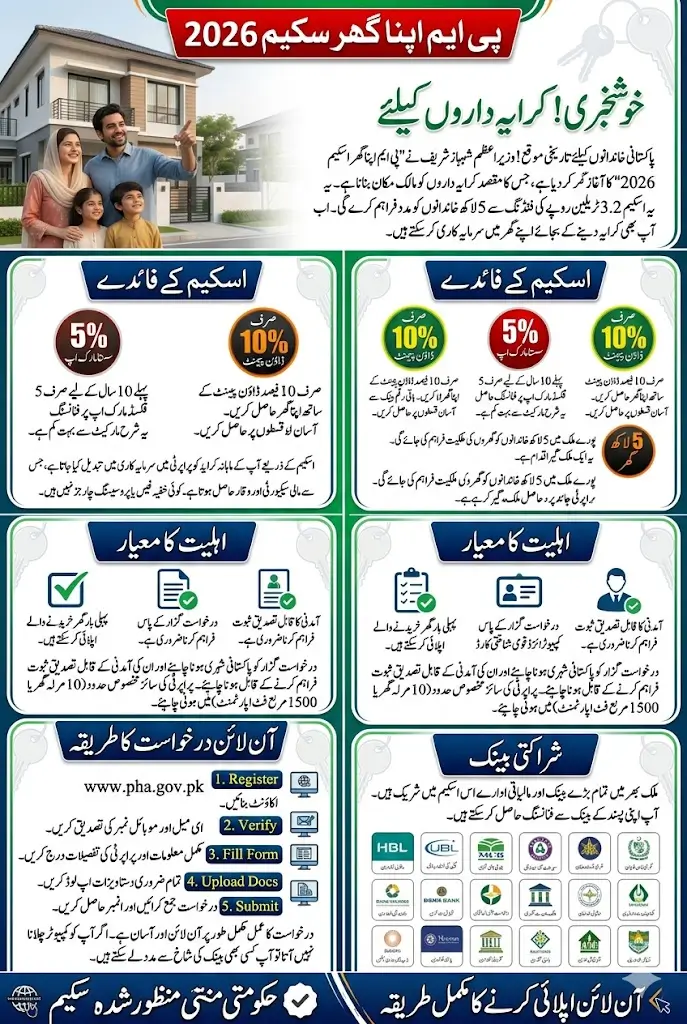
The scheme addresses a fundamental problem in Pakistani society. According to recent data, millions of Pakistanis spend between 30-50% of their monthly income on rent, yet they have absolutely nothing to show for it at the end of their rental period. Under the PM Apna Ghar Scheme, that same money now becomes an investment in your own property. The government has made this possible by offering subsidized interest rates, flexible repayment terms, and remarkably simple eligibility requirements that focus on whether you have a steady income rather than how much money you already have saved up.
You Can Also Read: Wazir-E-Azam Apna Ghar Program
What Exactly is PM Apna Ghar Scheme and How Does It Work?
The Wazir-e-Azam Apna Ghar Scheme 2026 is a government-backed housing finance initiative specifically designed to revolutionize real estate accessibility for middle and lower-income Pakistanis. Unlike traditional bank loans that require massive down payments and extensive documentation, this scheme has been deliberately structured to make homeownership achievable for people who work as salaried employees, small business owners, or even daily wage earners. The government has committed Rs. 3.2 trillion to this initiative, which is an extraordinary amount of money dedicated to solving the housing crisis that affects millions of Pakistani families.
The core purpose of this scheme is beautifully simple: to transition Pakistani families from being permanent renters to being homeowners. Every month, millions of Pakistanis hand over their hard-earned money to landlords who provide nothing but a place to sleep. The PM Apna Ghar Scheme changes this equation entirely. Instead of watching your rent money disappear forever, your monthly payments now go towards building equity in a property that belongs to you and your family. This is fundamentally transformative for the financial security and dignity of ordinary Pakistanis.
The scheme operates through a partnership between the government, commercial banks, Islamic banks, and microfinance institutions. When you get approved under this scheme, your monthly installment includes both the principal amount and the interest cost, but here is the crucial part: the government absorbs a significant portion of the interest cost, making your monthly payment far more affordable than it would be under regular commercial lending terms. This subsidy structure means that you are effectively getting financial assistance from the government every single month you make a payment.
You Can Also Read: Wazir-E-Azam Apna Ghar Program 2026 Registration
Key aspects of the scheme structure include:
- The government has allocated an unprecedented Rs. 3.2 trillion to finance this entire initiative across the country
- The target is to finance 500,000 homes over the next five years, affecting millions of family members
- Loans can range from Rs. 10 lakh to Rs. 1 crore depending on your income and financial capacity
- The scheme covers both purchasing an existing property and constructing a new one from scratch
- The government actively subsidizes the interest rate for the first 10 years, keeping it at just 5% markup
- After the initial 10 years, the remaining loan period operates at market rate interest
- There are absolutely no hidden fees, processing charges, or prepayment penalties involved
Understanding the Complete Eligibility Criteria and Requirements
To be eligible for the PM Apna Ghar Scheme 2026, you need to meet several important criteria that the government has established. These requirements have been deliberately kept reasonable and achievable for the average Pakistani citizen. The most fundamental requirement is that you must be a first-time homebuyer, which means you cannot currently own any residential property in Pakistan. This requirement exists because the government wants to help people who have never had the opportunity to own a home, not to provide additional properties to those who already have significant real estate holdings.
You must be a Pakistani citizen with a valid CNIC (Computerized National Identity Card) and you must be able to demonstrate a stable and verifiable source of income. Your income can come from a salaried job, running your own business, working in a profession, or any other legitimate source of revenue. The key requirement is that you can show proof of this income through documents like salary slips, bank statements, business records, or tax returns. You must also ensure that you have never defaulted on any bank loan in the past, as being classified as a bank defaulter will automatically disqualify you from this scheme.
The property you wish to purchase or construct must fall within specific size limits. You can buy or build a house up to 10 marla in area, or if you prefer an apartment, it cannot exceed 1,500 square feet. These size restrictions ensure that the government’s subsidized loans are being used to help people buy reasonable family homes, not luxury properties. The scheme covers both purchasing an existing property from the open market and constructing a brand new house from the ground up, giving you complete flexibility in how you want to obtain your home.
Your eligibility requirements must include:
- You must be a Pakistani citizen with full legal identity proof
- You must have a valid CNIC that is currently active and not expired
- You must be applying as a first-time homebuyer with no existing property ownership
- You must have a documented and verifiable source of monthly or annual income
- You must never have been classified as a bank defaulter by any financial institution
- You must not have any pending legal cases against you in property matters
- Your property size must be within the specified limits (10 marla house or 1,500 sq ft apartment)
You Can Also Read: E Learn She Earn Program 2026 Online Application
How Much Money Can You Borrow and What Will Your Monthly Payments Actually Be?
The loan amounts under the PM Apna Ghar Scheme have been carefully calibrated to match the financial capacity of middle and lower-income Pakistani families. The scheme offers loans ranging from a minimum of Rs. 25 lakh to a maximum of Rs. 1 crore. Most importantly, you are not required to have a massive down payment saved up. Instead, the scheme operates on a 90% Loan-to-Value (LTV) ratio, which means the bank finances 90% of the property cost and you only need to contribute just 10% from your own savings.
Let me give you a practical example to show how this actually works in real life. If you want to purchase a house valued at Rs. 50 lakh, you would normally need to save Rs. 20-25 lakh as a down payment to get a traditional bank loan. Under the PM Apna Ghar Scheme, you only need to provide Rs. 5 lakh (which is 10% of the total), and the bank will finance the remaining Rs. 45 lakh. This makes homeownership dramatically more achievable for people who have been struggling to save large amounts of money.
Your monthly installment depends on three main factors: the total loan amount you borrow, the interest rate charged, and the number of years you choose to repay the loan. The repayment period can extend up to 20 years, which means your monthly payments are significantly smaller than they would be with a shorter loan term. For someone earning Rs. 50,000 per month, the maximum monthly installment they could afford would be calculated based on their Debt-to-Income Ratio (DBR), typically around 45% of their monthly income. This means they could comfortably afford a monthly installment of approximately Rs. 22,500.
The monthly installment figures under this scheme are remarkably affordable when you compare them to what people are currently paying in rent:
- For a Rs. 25 lakh loan with a 20-year repayment period, the monthly installment is Rs. 16,499
- For a Rs. 50 lakh loan with a 20-year repayment period, the monthly installment is Rs. 32,997
- For a Rs. 75 lakh loan with a 20-year repayment period, the monthly installment is Rs. 49,497
- For a Rs. 1 crore loan with a 20-year repayment period, the monthly installment is Rs. 65,996
What makes these numbers truly significant is comparing them to current rental costs in major Pakistani cities. In Karachi, Lahore, and Islamabad, a decent apartment costs Rs. 15,000 to Rs. 35,000 in monthly rent, and most renters have no hope of owning the property even after decades of payments. Under the PM Apna Ghar Scheme, you could be paying a similar amount and actually building ownership equity with every payment.
You Can Also Read: Sindh Expands Pink EV Scooty Scheme
PM Apna Ghar Scheme 2026 Loan Details and Monthly Payment Breakdown
| Loan Amount | Monthly Installment (20-year tenure) | Estimated Total Interest Paid | Tenure Options |
|---|---|---|---|
| Rs. 25 Lakh | Rs. 16,499 | Rs. 8-10 Lakh | 10-20 Years |
| Rs. 50 Lakh | Rs. 32,997 | Rs. 16-20 Lakh | 10-20 Years |
| Rs. 75 Lakh | Rs. 49,497 | Rs. 24-30 Lakh | 10-20 Years |
| Rs. 1 Crore | Rs. 65,996 | Rs. 32-40 Lakh | 10-20 Years |
This table demonstrates the accessibility of the scheme across different income brackets. A person earning Rs. 40,000 monthly could comfortably afford the Rs. 25 lakh loan option, while someone earning Rs. 75,000 monthly could consider the Rs. 50 lakh to Rs. 75 lakh range. The flexibility of tenure options (choosing between 10 and 20 years) allows you to customize your repayment plan based on your personal financial situation and career expectations.
Step-by-Step Online Application Process on the Government Portal
Applying for the PM Apna Ghar Scheme online is a straightforward process that you can complete from the comfort of your home. The entire application happens through the official government portal, and the process has been deliberately simplified so that even people with limited computer knowledge can navigate it successfully. If you are not comfortable using computers, most participating banks will help you fill out the application at their branch offices, so you have options.
The first step in the application process is to create your account on the official PHA portal at www.pha.gov.pk. You will need to provide your CNIC number, valid email address, and mobile phone number. The government will send you a verification code via SMS and email to confirm that you are the genuine owner of these contact details. Once you have successfully verified your identity, your account will be activated and you can proceed to the next stage.
After creating and verifying your account, you need to log in securely to the portal using your email and password. The system uses secure encryption technology to protect your personal and financial information, so you can be confident that your data is safe. Once you are logged in, you will see a dashboard with various options, and you need to look for the button labeled “Apply for Loan” and click on it.
When you click the Apply for Loan button, you will be presented with a comprehensive application form that asks for detailed information about yourself, your income, your family, and the property you want to purchase or construct. You need to fill out this form with complete accuracy because any discrepancies between your application form and your original documents can lead to rejection or delays. The form includes sections for:
- Your personal information including full name, date of birth, and family details
- Your employment or business information and monthly income documentation
- Details about the property you want to acquire, its location, and estimated cost
- Information about any existing bank accounts or financial relationships
- Your preferred loan amount and desired repayment period
- Contact information and communication preferences
Once you have filled out the entire application form with all the necessary details, you should carefully review the entire form before submitting it. Check that all numbers are correct, all names are spelled correctly, and all information is accurate and complete. Many applications get rejected simply because of small errors that could have been caught with careful review. After you are completely satisfied with the accuracy of your information, you can submit the application for processing. The government system will immediately send you a confirmation message and provide you with an application reference number that you can use to track your application status online.
You Can Also Read: Pakistan Replaces Electricity Subsidies
The online application process involves:
- Creating an account with verified email and mobile number for account security
- Logging in with your credentials and navigating to the application section
- Filling out a comprehensive form with personal, financial, and property details
- Uploading scanned copies of all required documents to the online portal
- Reviewing the complete application for accuracy before final submission
- Receiving a confirmation and reference number for tracking your application progress
- Waiting for the government to process and verify your application details
Essential Documents You Must Gather and Submit
Before you begin your online application for the PM Apna Ghar Scheme 2026, you need to have all the necessary documents prepared and ready. The government has deliberately kept the list of required documents minimal and reasonable, understanding that ordinary Pakistanis may not have extensive documentation. However, every document you do provide must be genuine, current, and must match the information in your CNIC and NADRA records.
The most important document is your CNIC (Computerized National Identity Card). You will need to provide a clear photocopy of both sides of your CNIC, showing your complete identity details, photograph, and the official security features. Make sure the photocopy is clear enough that all text is readable and that the CNIC has not expired. If your CNIC has expired, you should renew it immediately before applying for the scheme, as an expired CNIC will result in automatic rejection of your application.
Your proof of income is equally crucial because the bank needs to verify that you actually earn the income you claim to be earning. If you are a salaried employee working for a company or government organization, you need to provide your salary slips from the last three months along with an employment letter from your employer stating your designation, salary amount, and employment status. If you are self-employed or run your own business, you need to provide business income documentation such as tax returns, business bank statements, or profit and loss statements from the last year.
Your bank statements are essential because they provide evidence of your financial stability and payment history. You should provide bank statements from at least the last three months, preferably six months, showing regular deposits and a healthy account balance. These statements demonstrate to the bank that you have a stable income and that you manage your finances responsibly.
If you are purchasing an existing property, you will need the property documents to prove ownership of the property you are buying. These documents typically include the property deed, mutation certificate, and other relevant documents from the revenue office that show the complete ownership and legal status of the property.
You Can Also Read: Govt Approves PAVE Program Vehicle Distribution
The required documents checklist includes:
- Original CNIC and photocopy of both sides for identity verification
- Employment letter from your employer stating your salary and position
- Salary slips from the last three months showing regular monthly income
- Bank statements from the last three to six months showing financial stability
- If self-employed, tax returns and business income documentation from last year
- Original property documents if purchasing an existing property
- Mutation certificate or property ownership proof from revenue office
- Two to three recent passport-size color photographs for official records
- Medical fitness certificate if required by the specific bank
- Character certificate from a government official or community leader
Participating Banks and Financial Institutions Offering This Scheme
One of the major strengths of the PM Apna Ghar Scheme is that it is offered through an extensive network of financial institutions across Pakistan. This means you have choice and flexibility in which bank you want to work with, and you can select the institution that you feel most comfortable dealing with. Whether you prefer a large multinational bank, a local Pakistani bank, an Islamic banking institution, or a microfinance bank, you have options available to you.
The major commercial banks participating in the scheme include Habib Bank Limited (HBL), which is Pakistan’s largest and oldest bank with the most extensive branch network across the country. United Bank Limited (UBL) is another major player offering competitive terms under the scheme. MCB Bank and Allied Bank are also active participants providing financing to thousands of applicants. Askari Bank caters particularly to the armed forces community but also serves the general public. Bank Al-Habib and Bank Alfalah are additional major banks offering this facility to their customers.
For those who prefer Islamic banking products that comply with Sharia law, Meezan Bank is the leading Islamic bank participating in the scheme, along with Dubai Islamic Bank which also offers Sharia-compliant financing options. These banks structure the loans in a way that is consistent with Islamic finance principles while still offering the same affordable rates and flexible terms as the conventional banks.
For people living in smaller cities and rural areas where large banks may not have branches, microfinance institutions provide crucial access to this scheme. Khushhali Microfinance Bank has extensive presence in rural Pakistan and serves small business owners and low-income earners. Mobilink Microfinance and U Microfinance Bank are also active in underserved areas, bringing this opportunity to communities that might otherwise be excluded from formal banking services.
The government has also established the House Building Finance Company (HBFL) as a dedicated institution specifically focused on housing finance. This company was set up decades ago to serve the housing finance needs of Pakistanis and plays an important role in the PM Apna Ghar Scheme. Additionally, banks like Soneri Bank, Sindh Bank, Faysal Bank, and JS Bank are also official participants in the scheme.
The list of participating financial institutions includes:
- Habib Bank Limited with the largest branch network across Pakistan
- United Bank Limited providing competitive rates and customer service
- MCB Bank, one of Pakistan’s oldest and most established banks
- Allied Bank with strong presence in northern Pakistan
- Askari Bank primarily serving the armed forces community
- Bank Al-Habib and Bank Alfalah catering to diverse customer segments
- National Bank of Pakistan as a government-backed institution
- Standard Chartered Bank bringing international banking standards
- Meezan Bank as Pakistan’s leading Islamic banking institution
- Dubai Islamic Bank offering Sharia-compliant financing products
Outstanding Benefits and Special Features of the Scheme
The PM Apna Ghar Scheme offers numerous benefits that make it genuinely different from traditional home financing options available in Pakistan. The most significant benefit is the government-subsidized interest rate that applies to the first 10 years of your loan repayment. During this initial period, the government keeps the markup rate fixed at just 5% per annum, which is substantially lower than the market rate that typically ranges from 15% to 20%. This means your effective cost of borrowing is dramatically reduced because the government is actively subsidizing a large portion of the interest that you would normally have to pay.
Another remarkable benefit is the absolute absence of processing fees. When you apply for traditional bank loans in Pakistan, banks typically charge processing fees ranging from 0.5% to 1.5% of the loan amount. On a loan of Rs. 50 lakh, this would mean paying Rs. 25,000 to Rs. 75,000 just in processing fees before you even receive the money. Under the PM Apna Ghar Scheme, there are no such fees. You pay nothing upfront, and the government has mandated that banks cannot charge any processing or documentation fees to applicants.
There is also no prepayment penalty in this scheme, which gives you tremendous flexibility. If your financial circumstances improve, if you receive a bonus or inheritance, or if you simply want to get out of debt faster, you can make additional payments on your loan at any time without incurring any penalty or fine. In traditional banking, prepayment often triggers penalties that discourage early repayment. This scheme encourages you to pay faster if you can, without any negative consequences.
The flexibility in repayment tenure is another huge advantage. You can choose to repay your loan over any period between 10 and 20 years, depending on what your financial situation allows. If you are relatively young and can afford higher monthly payments, you might choose a 10-year tenure and save significantly on total interest paid. If you prefer lower monthly payments to maintain more liquidity for other expenses, you can extend it to 20 years. This flexibility allows every applicant to customize their repayment schedule to match their personal financial capacity.
The scheme also offers a 90% Loan-to-Value ratio, which is extremely favorable. In traditional banking, you would typically be required to provide 20-30% as a down payment and the bank would finance only 70-80%. Under this scheme, you only need to provide 10% and the bank finances 90%. For someone who has been struggling to save a large down payment, this is a game-changing benefit that dramatically lowers the barrier to homeownership.
The key benefits of the PM Apna Ghar Scheme include:
- Government-subsidized interest rate of just 5% for the first 10 years of your loan
- Absolute zero processing fees or documentation charges from participating banks
- No prepayment penalties allowing you to pay early without facing fines
- Flexible repayment tenure ranging from 10 years to 20 years based on your preference
- High loan-to-value ratio of 90% meaning only 10% down payment is required
- Coverage for both property purchase and new construction from scratch
- Loans available for houses up to 10 marla or apartments up to 1,500 square feet
- Application can be completed entirely online from your home or at the bank
Common Issues Applicants Face and How to Resolve Them Quickly
While the PM Apna Ghar Scheme is designed to be accessible and straightforward, some applicants do face challenges during the application or approval process. Understanding these common issues and knowing how to resolve them can save you tremendous time and frustration. One of the most frequent problems is CNIC verification failure, which occurs when there are discrepancies between the CNIC information provided in your application and the records maintained by NADRA (the National Database and Registration Authority).
This issue typically happens when someone’s personal details have changed but they have not updated their CNIC. For example, if you got married and changed your surname, but your CNIC still shows your maiden or previous name, the system will flag this as a discrepancy. Similarly, if you have moved to a new address but your CNIC still shows your old address, this can cause verification problems. To resolve this issue, you need to visit the nearest NADRA office with your original CNIC and proof of the change (such as a marriage certificate or property ownership document). NADRA will update your biometric data and personal records, which usually takes one to two business days. After this update, you can submit your application again and the verification should pass.
Another common problem is application rejection due to incomplete or incorrect documentation. This happens when applicants submit their application but their supporting documents do not match what they wrote in the form, or when they forget to upload some required documents. To avoid this, carefully review the entire application form before submitting it and ensure that every piece of information matches your supporting documents exactly. Check that names are spelled the same way, that dates are consistent, and that all numbers are accurate. Before submitting, create a checklist of all required documents and verify that you have uploaded each one.
Some applicants experience delays in loan approval even after submitting complete applications. These delays typically occur because the bank is conducting additional verification or because there is a high volume of applications being processed. To address this issue, maintain regular contact with your designated bank branch and ask specifically about the status of your application. Provide your application reference number every time you communicate. If the bank requests additional documents or clarification, respond promptly and completely. Delays are often frustrating but are usually temporary and solvable with persistence and clear communication.
Occasionally, applicants face issues with property valuation disputes, where the bank’s assessment of the property value differs significantly from the asking price. This can happen if the property is in a less developed area or if the construction quality is questionable. If you face this issue, you can hire an independent property valuer to provide a professional assessment. You can also look for alternative properties that the bank is more comfortable financing, as this is often quicker than disputing the valuation.
Common issues and their solutions include:
- CNIC verification failures can be resolved by updating your biometric data at the nearest NADRA office
- Incomplete documentation requires you to review all forms carefully and upload each required document
- Loan approval delays should be addressed by maintaining regular contact with your bank branch
- Property valuation disputes can be resolved through independent professional property valuations
- Income verification problems may require additional documentation like tax returns or business licenses
- Address verification issues can be resolved with utility bills or property ownership documents
- Missing documents should be submitted immediately when the bank requests them
Frequently Asked Questions
Is the PM Apna Ghar Scheme available only in Punjab or is it nationwide?
The scheme is a federal initiative launched by the Prime Minister and is therefore available across all provinces of Pakistan. Whether you live in Punjab, Sindh, Khyber Pakhtunkhwa, Balochistan, or any of the other provinces, you are eligible to apply as long as you meet the basic eligibility criteria. The government has partnered with banks and financial institutions in every province to ensure that the scheme reaches all corners of the country.
What is the maximum loan amount I can borrow under this scheme?
The maximum loan amount under the scheme is Rs. 1 crore (10 million rupees). However, the actual amount you can borrow depends on your monthly income and your ability to service the debt. Banks typically allow you to borrow up to a certain multiple of your annual income, usually around 4 to 5 times. So if you earn Rs. 100,000 per month, you might qualify for a loan up to Rs. 60-75 lakh, but not necessarily the full 1 crore limit. Your bank will calculate your maximum eligible loan amount based on your income and financial profile.
What is the minimum and maximum monthly installment under this scheme?
The minimum monthly installment starts from Rs. 16,499 for a Rs. 25 lakh loan with a 20-year repayment period. The maximum monthly installment can go up to Rs. 65,996 for a Rs. 1 crore loan with a 20-year period. Of course, these figures can change based on the interest rate and the tenure you choose. If you opt for a shorter repayment period of 10 years instead of 20 years, your monthly installment will be higher but you will pay less total interest.
Can overseas Pakistanis apply for this scheme?
Yes, overseas Pakistanis can apply for the scheme, but there are some additional requirements. You will need to have a valid Pakistani CNIC, and you typically need to have a permanent residence or family member in Pakistan where the property will be located. Many overseas Pakistanis use this scheme to buy or build homes in Pakistan where their families live. Some banks may require additional documentation from overseas applicants, such as employment verification from their employer abroad or proof of regular remittances to Pakistan.
How long does the loan approval process actually take?
The approval timeline for the PM Apna Ghar Scheme typically ranges from 2 to 4 weeks from the date you submit your complete application with all required documents. However, this timeline can vary based on several factors. If all your documents are in order and your application is complete, you might get approval in as little as 10-15 days. If there are any discrepancies or missing documents, the approval can take 6-8 weeks or even longer as you wait for clarifications and additional documentation. The best way to ensure faster approval is to submit a complete, accurate application with all required documents on the first attempt.
Is there a deadline to apply for this scheme?
The government has not announced a specific deadline for applications, which suggests the scheme will continue as long as funds are available and the government’s objectives are not met. However, given that this is a massive undertaking with Rs. 3.2 trillion allocated and the goal of reaching 500,000 families, it is reasonable to expect that the scheme will operate for several years. That said, it is wise to apply sooner rather than later because government programs can change or be modified based on budget availability and political circumstances. The sooner you apply, the sooner you can start building equity in your own home.
Conclusion
The PM Apna Ghar Scheme 2026 represents a genuine and transformative opportunity for millions of Pakistanis who have been struggling with the burden of never-ending rent payments. For generations, ordinary Pakistanis have watched their money disappear into the pockets of landlords while never achieving the fundamental goal of owning their own home. The Prime Minister’s initiative directly addresses this injustice by making it financially and practically possible for people from all income levels to purchase or construct their own homes.
The numbers tell the story powerfully. A person currently paying Rs. 20,000 in monthly rent can switch to paying Rs. 16,499 as a monthly installment on their own property under this scheme. That same Rs. 20,000 that was benefiting no one suddenly becomes a building block toward homeownership. After 20 years, that person owns a property worth millions of rupees instead of having a receipt book full of rent receipts. The financial mathematics are compelling and favor every applicant who takes action today.