
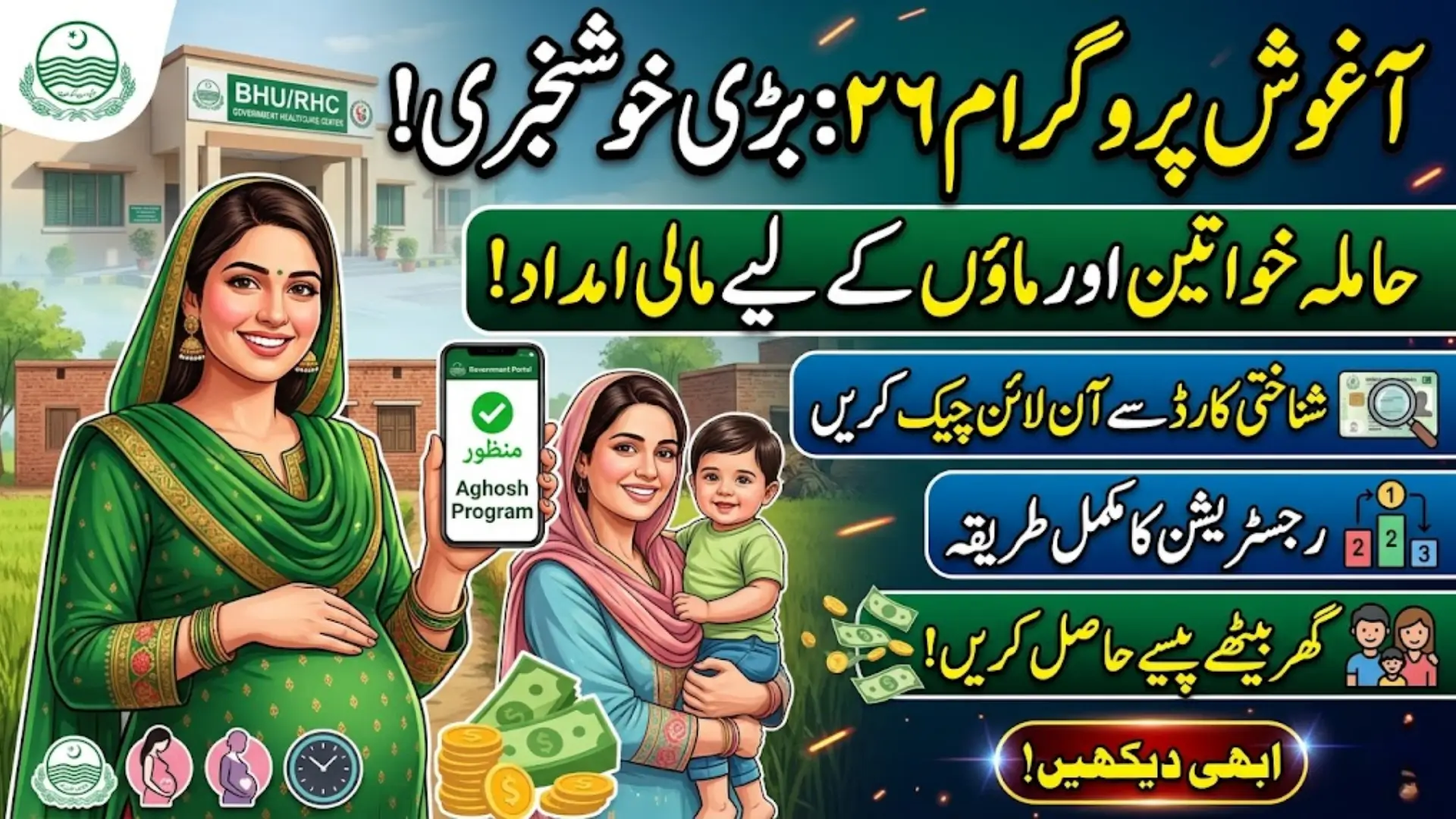
Aghosh Program Online Check Punjab by CNIC Login 2026
Aghosh Program Online Check Punjab by CNIC Login 2026 Pregnancy is one of the most difficult and sensitive periods in a woman’s life, especially for families living in rural and low-income areas of Punjab. In many villages across Pakistan, women still struggle to access proper medical facilities during pregnancy because transportation costs, medical expenses, medicines, and repeated hospital visits are financially impossible for poor households. Many mothers delay treatment or avoid hospitals completely because they simply cannot afford regular healthcare.

To address this growing problem, the Punjab Government launched the Aghosh Program, a special financial and healthcare support initiative for pregnant women, lactating mothers, and children under two years of age. The purpose of this scheme is not only to provide cash assistance but also to improve maternal and child healthcare through regular medical checkups, vaccinations, hospital monitoring, and safe delivery practices.
In 2026, thousands of women are searching online for Aghosh Program Online Check Punjab by CNIC Login 2026, payment details, eligibility criteria, registration methods, and district coverage information. Many applicants still face confusion regarding verification procedures, required documents, healthcare visit conditions, and installment tracking. This detailed guide explains every important detail in simple and easy language so ordinary Pakistani families can understand the complete process without difficulty.
You Can Also Read: Wazir E Azam Apna Ghar Program Ubl
What Is the Aghosh Program Punjab 2026?
The Aghosh Program Punjab is a welfare and healthcare support scheme launched for financially struggling women during pregnancy and early motherhood. The program mainly focuses on helping women receive proper healthcare services without worrying too much about transportation costs, medicines, hospital visits, and child healthcare expenses.
In many underdeveloped areas of Punjab, women often rely on unsafe home deliveries because hospitals are far away or expensive. Healthcare experts have repeatedly warned that delayed treatment during pregnancy can create dangerous complications for both mothers and newborn babies. The Aghosh Program was introduced to encourage women to stay connected with formal healthcare systems from the beginning of pregnancy until the child reaches two years of age.
The program mainly supports:
- Pregnant women
- Lactating mothers
- Mothers with children under 2 years
- Low-income households
- Rural families
- Women requiring regular healthcare monitoring
Women who participate in medical checkups and healthcare visits receive financial assistance in stages. This system encourages continuous healthcare monitoring instead of one-time support.
You Can Also Read: PMWww.pha.gov.pk Online Apply Your Complete Guide
Why the Aghosh Program Is Important in 2026
Even today, many villages in Punjab lack proper maternal healthcare awareness. Women often ignore symptoms during pregnancy because of poverty, family pressure, transportation issues, or fear of medical expenses. In some areas, pregnant women only visit hospitals during emergencies, which increases health risks for both mother and child.
The Aghosh Program has become important because it directly connects healthcare participation with financial support. This means women are encouraged to attend regular medical checkups, vaccination visits, and healthcare monitoring sessions in order to continue receiving installments. The government designed this system carefully to improve maternal health conditions in poor communities.
Some major healthcare problems the program tries to reduce include:
- Unsafe home deliveries
- Pregnancy complications
- Delayed medical treatment
- Child malnutrition
- Missed vaccinations
- Infant health risks
- Lack of healthcare awareness
- Financial pressure on poor families
Healthcare workers in many districts report that more women are now visiting government hospitals regularly because of this initiative. This improvement is especially visible in rural areas where healthcare awareness was previously very low.
You Can Also Read: Wazir-E-Azam Apna Ghar Program Apply
Main Objectives of the Aghosh Program
The Punjab Government launched the program with the goal of improving maternal and child healthcare across the province. The scheme is not simply about giving money to families. Instead, it focuses on creating long-term healthcare awareness while reducing financial stress for deserving households.
One of the biggest goals is to encourage women to visit hospitals regularly during pregnancy. Doctors say regular monitoring helps detect serious complications early, which can save lives and improve child health outcomes.
The program also aims to strengthen vaccination systems for newborn babies. Many children in villages miss important vaccines because parents avoid hospitals after childbirth. The Aghosh Program encourages families to continue healthcare visits even after delivery.
Main Goals of the Program
| Objective | Benefit for Families |
|---|---|
| Improve maternal healthcare | Safer pregnancies |
| Encourage hospital visits | Better medical monitoring |
| Promote child vaccinations | Stronger child protection |
| Reduce healthcare expenses | Financial relief for families |
| Support poor women | Better healthcare access |
| Encourage safe deliveries | Reduced pregnancy risks |
The government hopes this initiative will reduce maternal mortality rates and improve healthcare conditions in underdeveloped regions of Punjab over the coming years.
You Can Also Read: Wazir-E-Azam Apna Ghar Program 2026
Latest Aghosh Program 2026 Updates
In 2026, the Punjab Government continues expanding healthcare monitoring and digital verification systems under the Aghosh Program. Many districts now use improved registration records and CNIC verification systems to reduce delays and improve transparency.
Women can now check their registration status, payment details, and healthcare records more easily through online systems and government healthcare centers. However, many rural women still prefer offline verification because internet access remains limited in remote areas.
Recent updates in the program include:
- Improved CNIC verification system
- Faster registration processing
- Better healthcare monitoring records
- Expanded awareness campaigns
- Improved district-level coordination
- Easier payment tracking system
- Increased support for rural healthcare centers
Healthcare officials say these improvements are helping reduce confusion during registration and payment verification processes.
Who Can Apply for the Aghosh Program?
The program mainly targets deserving women from financially weak families who require healthcare assistance during pregnancy and early motherhood. Not every applicant automatically qualifies because the government prioritizes low-income households requiring urgent support.
Women must fulfill certain conditions before approval. Applicants are usually required to register through approved healthcare facilities and continue attending regular medical checkups throughout the program period.
Women eligible for the scheme include:
- Pregnant women living in Punjab
- Mothers with children under 2 years
- Women from low-income families
- Applicants with valid CNIC
- Women registered at approved health centers
Important requirements include:
- Regular healthcare visits
- Medical checkup participation
- Updated records
- Correct CNIC information
- Government healthcare registration
Women who miss appointments repeatedly may experience delays in installment payments because healthcare participation is a major condition of the scheme.
You Can Also Read: E Learn She Earn Program 2026 Online Application
Aghosh Program Online Check Punjab by CNIC Login 2026
Many applicants now prefer checking their eligibility and payment status online instead of repeatedly visiting hospitals or healthcare offices. The online verification system helps women save time, transportation costs, and unnecessary travel.
The process is simple if applicants enter correct information carefully. Women can verify whether their registration is approved, pending, or under review. They can also check installment details and healthcare monitoring records through the system.
Step By Step Online Verification Process
Step 1 – Visit the Official Health Portal
Applicants should open the official Punjab healthcare portal related to the Aghosh Program. Always use trusted government sources instead of unofficial websites or social media links.
Step 2 – Open the Aghosh Program Section
After entering the website, locate the Aghosh Program or maternal healthcare section from the available categories.
Step 3 – Enter CNIC Number
Applicants should carefully type their valid CNIC number without spaces or incorrect digits. Even small mistakes can create verification errors.
Step 4 – Submit Information
Click the check status or login button to continue. The system may display:
- Registration approval
- Eligibility confirmation
- Installment details
- Healthcare visit history
- Pending verification notices
- Payment processing updates
Women should also keep their registered mobile numbers active because some notifications may be sent through SMS.
You Can Also Read: Sindh Expands Pink EV Scooty Scheme
Offline Verification Method for Rural Women
Although online systems are improving, many women in villages still do not have internet access or smartphones. Because of this, the government continues offering offline verification facilities through healthcare centers and hospitals.
In many rural communities, women feel more comfortable speaking directly with healthcare workers rather than using online systems. Healthcare staff can check records and guide applicants regarding missing documents or pending verification issues.
Women can verify their records through:
- Basic Health Units (BHUs)
- Rural Health Centers (RHCs)
- Government hospitals
- Maternal healthcare centers
- Lady health workers
- District healthcare offices
Healthcare officials encourage rural women to remain connected with nearby healthcare centers throughout pregnancy.
How Aghosh Program Payments Are Distributed
The Aghosh Program payment system works in stages. Financial assistance is linked with healthcare activities instead of one-time registration only. This system encourages women to complete regular medical checkups and continue healthcare monitoring for both mother and child.
Women usually receive support after completing specific healthcare visits. The total amount may vary slightly depending on district-level implementation and medical monitoring records.
Payments are generally connected with:
- Initial registration
- Pregnancy checkups
- Delivery monitoring
- Child vaccination visits
- Follow-up healthcare visits
- Child healthcare tracking
Many women use these payments for transportation, nutritional food, medicines, and baby-related expenses. Healthcare workers say the support may look small for some families, but for poor households it becomes an important source of relief.
Importance of Regular Medical Checkups
The biggest purpose of the Aghosh Program is improving healthcare participation. Doctors repeatedly explain that pregnancy complications can become dangerous if women avoid regular medical checkups.
Routine monitoring helps doctors identify blood pressure problems, nutrition deficiencies, child growth complications, and other health risks before they become severe.
Regular checkups help monitor:
- Blood pressure levels
- Baby growth and development
- Mother’s nutrition
- Pregnancy complications
- Vaccination schedules
- General maternal health
Healthcare experts say many serious childbirth complications can be prevented through early treatment and regular hospital visits.
Required Documents for Registration
One of the most common reasons for delayed verification is incomplete documentation. Many women visit healthcare centers without proper records, which slows the registration process.
Applicants should prepare all required documents before visiting the registration center.
Required documents usually include:
- Original CNIC
- Medical registration slip
- Pregnancy healthcare records
- Child birth documents if applicable
- Active mobile number
- Vaccination records
Applicants should also keep photocopies of important documents safely because lost records may create future problems during verification.
Common Problems During Registration
Many women face difficulties during registration because of small mistakes or lack of awareness about official procedures. In rural areas, incorrect information often causes delays in verification and payment processing.
Some common registration problems include:
- Incorrect CNIC entry
- Missed healthcare appointments
- Unregistered healthcare facilities
- Outdated family information
- Wrong mobile number
- Incomplete healthcare records
Women should immediately update information after childbirth or address changes to avoid future complications.
Practical Tips for Successful Registration
Women who carefully follow official instructions usually face fewer problems during registration and payment verification. Healthcare workers advise applicants to remain organized and connected with nearby health centers throughout pregnancy.
Important practical advice includes:
- Register early during pregnancy
- Attend every scheduled medical visit
- Keep healthcare slips safe
- Maintain updated records
- Use only official information sources
- Avoid fake agents and middlemen
- Keep CNIC information accurate
Many scams target poor families by demanding registration fees. Applicants should remember that official registration is completely free.
How the Program Helps Rural Communities
The Aghosh Program is especially important for rural Punjab where healthcare facilities remain limited and transportation expenses are high. In many villages, women previously avoided hospitals completely because travel costs alone were unaffordable.
The program helps poor families connect with proper healthcare systems while reducing financial pressure. Many healthcare workers report that awareness about maternal health has improved significantly after the launch of the scheme.
Major benefits for rural communities include:
- Increased hospital visits
- Better maternal healthcare awareness
- Improved vaccination participation
- Safer delivery monitoring
- Reduced healthcare delays
- Financial relief for transportation expenses
This support is helping many families understand the importance of regular healthcare during pregnancy and early childhood.
Difference Between Aghosh Program and BISP
Many Pakistani families confuse the Aghosh Program with BISP because both schemes provide financial support to low-income households. However, the purpose of both programs is completely different.
The Aghosh Program mainly focuses on maternal and child healthcare, while BISP provides broader financial assistance to deserving families.
Major Difference Between Both Programs
- Aghosh Program focuses on pregnancy and child healthcare
- BISP provides general financial support
- Aghosh payments depend on healthcare participation
- BISP eligibility uses separate poverty evaluation systems
- Women may qualify for both programs separately
Families should understand that healthcare monitoring is the main condition under the Aghosh Program.
Can Women Apply Without Internet Access?
Yes, internet access is not compulsory for registration or verification. The government understands that many rural women still lack smartphones or stable internet facilities.
Women can complete most procedures through physical healthcare centers and government hospitals.
Offline support is available through:
- Government hospitals
- BHUs
- Rural healthcare centers
- Lady health workers
- Maternal healthcare units
Healthcare staff usually guide applicants regarding registration, verification, and installment updates.
Frequently Asked Questions
Can women from all Punjab districts apply?
Program coverage may vary depending on district implementation phases and healthcare availability.
Is online CNIC checking compulsory?
No, applicants can also verify their information through healthcare centers and hospitals.
How much financial assistance is provided?
The total support depends on healthcare visits, district implementation, and verification stages.
Can mothers with newborn babies apply?
Yes, mothers with children under two years may qualify under the program.
What happens if medical appointments are missed?
Installments may be delayed or temporarily suspended.
Is registration free?
Yes, official registration and verification are completely free.
Can women receive both BISP and Aghosh Program support?
Yes, women may qualify for both schemes separately if they meet eligibility conditions.
Are private hospitals accepted?
Usually government-approved healthcare facilities are preferred for registration and monitoring.
Conclusion
The Aghosh Program Punjab 2026 is becoming one of the most important maternal healthcare initiatives for low-income families in Punjab. For thousands of poor women, especially those living in villages and remote areas, the scheme provides financial relief during one of the most difficult stages of life.
By connecting financial assistance with regular healthcare visits, the program encourages safer pregnancies, proper vaccinations, hospital monitoring, and improved child healthcare. This approach is helping reduce healthcare negligence among poor families who previously avoided hospitals because of financial pressure.