
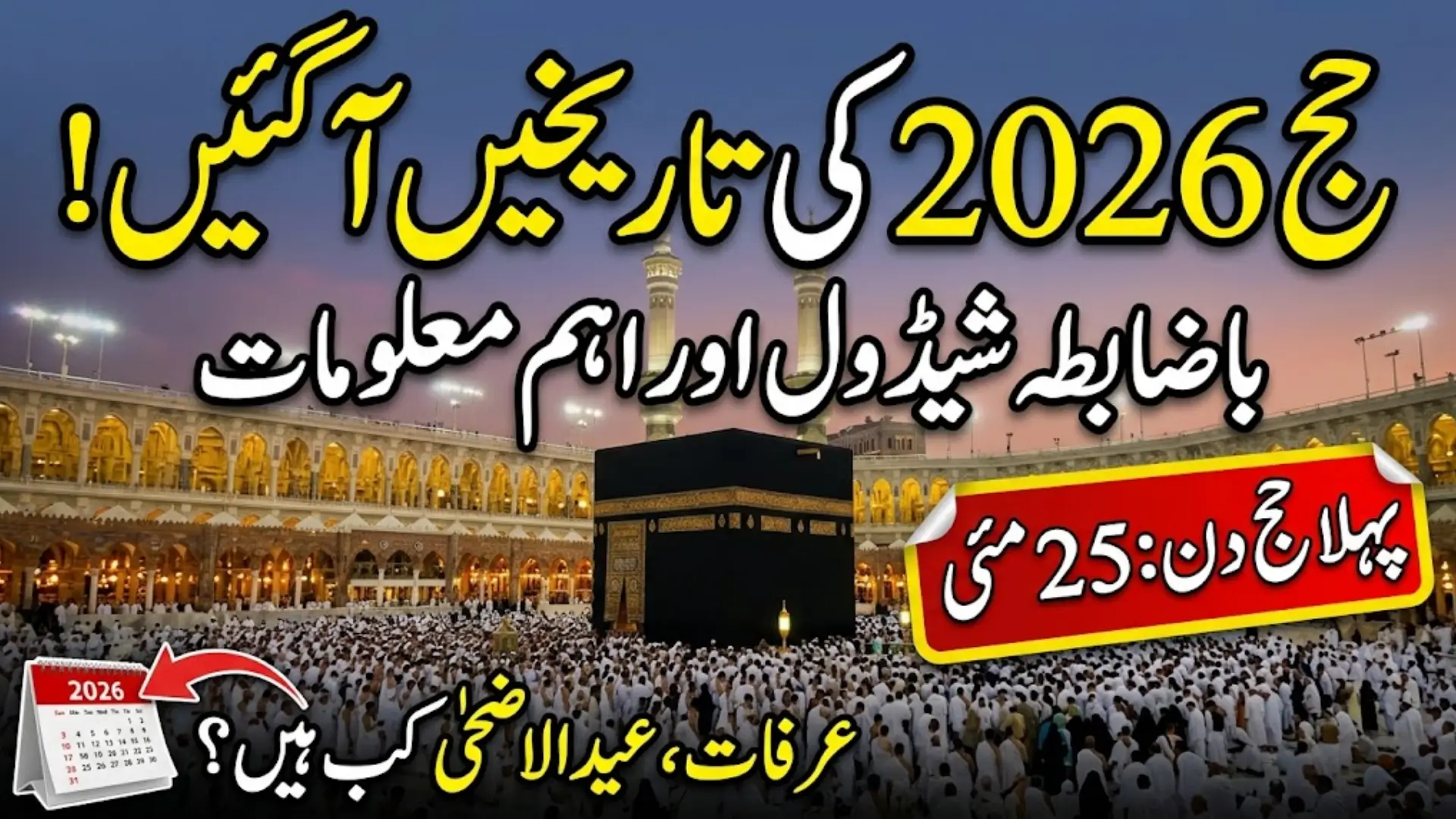
Hajj Date 2026
Eid ul Adha 2026 Countdown
Pakistan mein Eid ul Azha tak kitna time baki hai
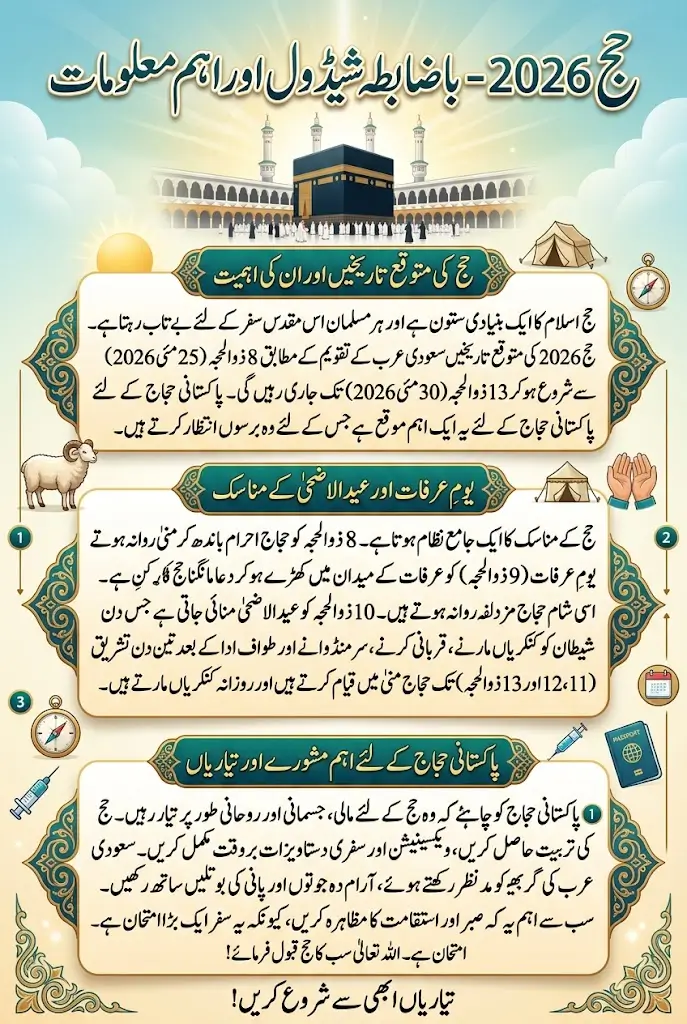
Hajj Date 2026 Hajj is one of the most important pillars of Islam, and every year millions of Muslims from around the world travel to Saudi Arabia to perform this sacred pilgrimage. Muslims in Pakistan also wait eagerly for the official Hajj dates so they can prepare spiritually, financially, and physically for the journey. According to the expected Islamic calendar, Hajj 2026 is likely to begin from Monday, 25 May 2026, and continue until Saturday, 30 May 2026. However, the final confirmation will depend on the moon sighting announcement by Saudi Arabia.
This year, Saudi authorities are expecting nearly two million pilgrims from different countries, including thousands from Pakistan under both the government and private Hajj schemes. Flights from Pakistan have already started preparations, and pilgrims are being advised to complete their training, vaccination, and travel documentation early.
For many Pakistani families, Hajj is not only a religious duty but also an emotional and life-changing experience. People spend years saving money and waiting for their turn. In this article, you will find complete details about Hajj 2026 dates, rituals, important duas, travel guidance, and everything Pakistani pilgrims need to know in simple language.
You Can Also Read: Online QR Code Verification for Cross Bill Subsidy
Hajj 2026 Confirmed Dates in Pakistan and Saudi Arabia
According to the expected Umm al-Qura calendar of Saudi Arabia, Hajj 2026 will begin on 8 Dhul Hijjah 1447 AH, which is expected to fall on Monday, 25 May 2026. The Day of Arafah is expected on Tuesday, 26 May 2026, while Eid ul Adha will likely be celebrated on Wednesday, 27 May 2026.
In Pakistan, the exact Eid ul Adha date may slightly differ depending on local moon sighting decisions. Usually, Pakistan celebrates Eid one day after Saudi Arabia, but sometimes both countries observe it on the same date if the moon is sighted together.
Many Pakistani pilgrims closely follow Saudi announcements because Hajj rituals are performed according to the Saudi Islamic calendar. Final confirmation is usually announced by the Saudi Supreme Court after the Dhul Hijjah moon sighting around 16 or 17 May 2026.
Hajj 2026 Important Dates
| Islamic Date | Gregorian Date | Event |
|---|---|---|
| 8 Dhul Hijjah 1447 AH | Monday, 25 May 2026 | Start of Hajj |
| 9 Dhul Hijjah 1447 AH | Tuesday, 26 May 2026 | Day of Arafah |
| 10 Dhul Hijjah 1447 AH | Wednesday, 27 May 2026 | Eid ul Adha |
| 11 Dhul Hijjah | Thursday, 28 May 2026 | First Day of Tashreeq |
| 12 Dhul Hijjah | Friday, 29 May 2026 | Second Day of Tashreeq |
| 13 Dhul Hijjah | Saturday, 30 May 2026 | Final Day of Hajj |
Why Hajj Holds Great Importance for Muslims
Hajj is obligatory once in a lifetime for every Muslim who is financially and physically able to perform it. It is the fifth pillar of Islam and teaches equality, patience, sacrifice, and obedience to Allah. During Hajj, Muslims from every race, language, and country stand together wearing simple white clothes, showing unity before Allah.
For Pakistani pilgrims, the journey of Hajj often becomes the most memorable part of life. Many people describe it as a spiritual rebirth. Pilgrims leave behind worldly distractions and spend days in worship, dua, and remembrance of Allah.
Hajj also reminds Muslims of the sacrifices of Prophet Ibrahim (AS), Hazrat Ismail (AS), and Hazrat Hajra (AS). Every ritual performed during Hajj has a deep Islamic history connected with their lives.
You Can Also Read: Punjab Eid Waste Fine Rs50,000 for Illegal
Full Hajj 2026 Day-by-Day Schedule
Hajj rituals are completed over six days. Each day has its own importance and specific worship activities. Pilgrims must carefully follow the sequence to complete Hajj correctly.
- Entering Ihram
- Staying in Mina
- Wuquf at Arafat
- Night stay in Muzdalifah
- Stoning the Jamarat
- Performing Qurbani
- Tawaf al-Ifadah
- Farewell Tawaf
Pakistani pilgrims are usually guided by Hajj group leaders and scholars who help them perform rituals properly. Saudi authorities also provide maps, signs, and mobile applications for guidance.
Day 1 – 8 Dhul Hijjah: Beginning of Hajj
The first day of Hajj is called Yawm at-Tarwiyah. On this day, pilgrims wear Ihram and make the intention for Hajj. Men wear two white unstitched cloths while women wear simple modest dresses.
Pilgrims continuously recite the Talbiyah while travelling from Makkah to Mina. Mina is a large tent city where millions of pilgrims stay together. They offer prayers and spend the night there in worship.
Talbiyah of Hajj
لَبَّيْكَ اللَّهُمَّ لَبَّيْكَ
“Here I am, O Allah, here I am.”
This powerful recitation creates a spiritual atmosphere that many pilgrims never forget throughout their lives.
Day 2 – Day of Arafah 2026
The Day of Arafah is considered the most important day of Hajj. Pilgrims travel from Mina to the plains of Arafat after Fajr prayer. Standing in Arafat and making dua is known as Wuquf, which is the central pillar of Hajj.
The atmosphere in Arafat is emotional and deeply spiritual. Millions of Muslims raise their hands together, asking Allah for forgiveness, mercy, and blessings. Scholars often describe this day as a glimpse of the Day of Judgment.
For Muslims in Pakistan who are not performing Hajj, fasting on the Day of Arafah is highly recommended. According to Hadith, fasting on this day removes sins of the previous and coming year.
You Can Also Read: Sindh Eid Ul Adha Holidays Four-Day
Important Acts on the Day of Arafah
- Make sincere dua
- Recite Quran
- Seek forgiveness
- Send Durood on Prophet Muhammad ﷺ
- Avoid unnecessary talk and arguments
After sunset, pilgrims leave for Muzdalifah where they spend the night under the open sky and collect pebbles for the stoning ritual.
Day 3 – Eid ul Adha and Major Hajj Rituals
The 10th of Dhul Hijjah is the day of Eid ul Adha and also the busiest day of Hajj. Pilgrims return to Mina and perform several important rituals.
First, pilgrims stone the largest pillar called Jamarat al-Aqabah using seven pebbles. This act symbolizes rejecting Shaytan. After that, pilgrims perform Qurbani in remembrance of Prophet Ibrahim’s sacrifice.
Men usually shave their heads while women trim a small portion of hair. Pilgrims then travel to Masjid al-Haram to perform Tawaf al-Ifadah around the Holy Kaaba.
Days of Tashreeq Explained
The 11th, 12th, and 13th of Dhul Hijjah are known as the Days of Tashreeq. Pilgrims remain in Mina and continue the ritual of stoning all three Jamarat daily.
These days are filled with worship, Takbeerat, and remembrance of Allah. Pilgrims also spend time resting because Hajj involves a lot of walking and physical effort, especially in hot weather conditions.
Takbeerat of Tashreeq
- Allahu Akbar Allahu Akbar
- La ilaha illallah
- Wallahu Akbar
- Allahu Akbar wa lillahil hamd
Muslims in Pakistan also recite these Takbeerat after every farz prayer during Eid days.
You Can Also Read: BISP 8171 May 2026 Payment Released
Hajj 2026 Rituals Step-by-Step Table
| Ritual | Purpose |
|---|---|
| Ihram | Entering sacred state |
| Tawaf | Circling the Kaaba |
| Sa’i | Walking between Safa and Marwa |
| Wuquf at Arafat | Main pillar of Hajj |
| Muzdalifah Stay | Worship and pebble collection |
| Ramy al-Jamarat | Symbolic rejection of Shaytan |
| Qurbani | Following Prophet Ibrahim (AS) |
| Tawaf al-Wida | Farewell to Kaaba |
Three Types of Hajj Explained
There are three types of Hajj that pilgrims can choose according to their circumstances and guidance from scholars.
Hajj Tamattu
This is the most common form for Pakistani pilgrims. In this type, pilgrims perform Umrah first and later perform Hajj separately.
Hajj Qiran
In Hajj Qiran, Umrah and Hajj are combined together in one Ihram without removing it in between.
Hajj Ifrad
This type includes only Hajj without Umrah. It is less common among international pilgrims.
Common Mistakes Pakistani Pilgrims Should Avoid
Every year many pilgrims make avoidable mistakes due to lack of preparation or misunderstanding of rituals. Learning before departure can save pilgrims from stress and confusion.
Common Mistakes Include:
- Not learning Ihram rules properly
- Missing important timings
- Pushing during Tawaf
- Carrying too much luggage
- Ignoring health and hydration
- Forgetting important documents
Experienced pilgrims often advise newcomers to stay calm and patient because overcrowding is normal during Hajj.
You Can Also Read: Prime Minister Eid Package 2026
Hajj 2026 Preparations for Pakistani Pilgrims
Pakistani pilgrims should begin preparations months before departure. Vaccinations, passport validity, visa processing, and physical fitness are very important for a smooth journey.
Saudi Arabia experiences extreme heat during May, so pilgrims should prepare for long walks and high temperatures. Comfortable shoes, water bottles, medicines, and light clothing are necessary items.
Important Preparation Checklist
- Valid passport
- Hajj visa
- Vaccination certificates
- Comfortable footwear
- Unscented soap and toiletries
- Prayer mat and Quran
- Basic medicines
Pilgrims are also advised to attend Hajj training sessions arranged by the Ministry of Religious Affairs or private operators.
How Muslims in Pakistan Can Earn Hajj Rewards From Home
Not everyone can travel for Hajj every year, but the first ten days of Dhul Hijjah are full of blessings for all Muslims. People staying in Pakistan can still gain huge rewards through worship and good deeds.
Fasting on the Day of Arafah is especially important for non-pilgrims. Charity, Quran recitation, Nafl prayers, and helping the poor also carry great reward during these days.
Good Deeds During Dhul Hijjah
- Fast on 9 Dhul Hijjah
- Give charity
- Perform Qurbani
- Increase Quran recitation
- Make sincere dua
- Help needy families
Many Pakistani families also arrange collective Qurbani and distribute meat among poor communities during Eid ul Adha.
Hajj 2026 vs Umrah Difference
Many people confuse Hajj and Umrah, but both are different acts of worship. Hajj is compulsory once in a lifetime for those who can afford it, while Umrah is optional.
Hajj can only be performed during specific days of Dhul Hijjah, while Umrah can be performed almost throughout the year.
Hajj includes additional rituals like Arafat, Muzdalifah, Mina, and stoning the Jamarat, which are not part of Umrah.
You Can Also Read: Petrol & Diesel Prices Reduced Again
FAQs
What is the expected Hajj 2026 date in Pakistan?
Hajj 2026 is expected to start on Monday, 25 May 2026, subject to moon sighting confirmation in Saudi Arabia.
When is Eid ul Adha 2026 in Pakistan?
Eid ul Adha is expected on Wednesday, 27 May 2026, or one day later depending on moon sighting in Pakistan.
How long does Hajj last?
Hajj rituals continue for around five to six days from 8 Dhul Hijjah to 13 Dhul Hijjah.
Can women perform Hajj alone?
Saudi Arabia has eased some restrictions in recent years, but pilgrims should still follow official Pakistani Hajj policies and Islamic guidance.
Final Words
Hajj 2026 is now very close, and preparations have already started across Pakistan. For pilgrims, this journey is not just travel; it is a once-in-a-lifetime spiritual experience that changes hearts and lives forever.
Whether you are travelling to Makkah this year or staying in Pakistan, the days of Dhul Hijjah are among the most blessed days in Islam. Use these days for worship, forgiveness, charity, and strengthening your connection with Allah.